

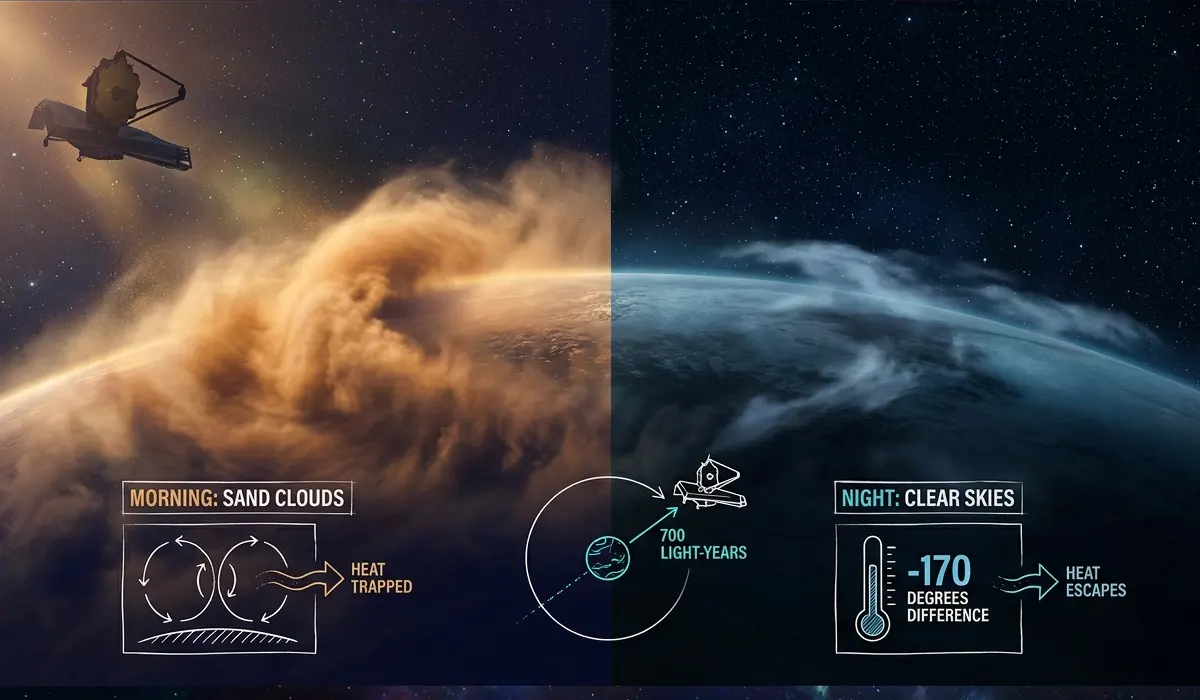
A planet 700 light years away with sand clouds sounds like fiction, but JWST has now shown that some distant worlds really do have weather we can track. On WASP-94A b, clouds form, move, and fade in patterns that reveal how heat and wind shape a fierce atmosphere.
- The Planet Behind the Weather Report
- Why JWST Could Read the Atmosphere
- Why the Morning Side Is Cloudier
- What This Means for Exoplanet Science
- How Scientists Found the Pattern
- Why Hot Jupiters Matter So Much
- Why This Looks More Like Real Weather Than a Static Atmosphere
- What Astronomers Will Want to Do Next
- Why This Story Deserves Attention
That matters because this is not a guess built from a pretty illustration. It comes from spectra, transits, and a careful look at how different parts of the same planet behave. The planet 700 light years away with sand clouds is not just strange. It is a test case for how atmospheres work under extreme conditions.
What looks like a single globe from Earth is actually two very different hemispheres forced into the same orbit. One side stays locked in permanent daylight, while the other remains in permanent darkness. The boundary between them drives winds, clouds, and chemistry in ways that now leave a measurable signal.
The Planet Behind the Weather Report
WASP-94A b is a hot Jupiter, which means it is a gas giant packed very close to its star. It orbits in just about four days. That short year makes it easier for astronomers to follow its motion, even though the planet sits nearly 700 light years away from Earth.
The planet 700 light years away with sand clouds became useful to study because it is tidally locked. One hemisphere faces the star all the time. The other never sees daylight. That kind of setup creates a hard temperature split, and on a planet this hot, temperature drives everything from wind to cloud formation.
Astronomers first found the planet through the wobble it causes in its star. They later studied it as it crossed the star’s face. During those transits, starlight passed through the planet’s upper atmosphere. That gave researchers a chance to detect chemical fingerprints and look for clouds at the same time.
Why JWST Could Read the Atmosphere
JWST works in infrared light, which is especially useful for hot planets. The telescope can detect faint changes in starlight as molecules and particles absorb specific wavelengths. That is how scientists learn what is in an atmosphere without ever seeing the planet directly.
But clouds make this job harder. Dense cloud layers can hide or weaken the spectral lines that astronomers want to measure. A cloudy atmosphere can look flatter and less detailed than it really is. That is why the cloud pattern on WASP-94A b matters just as much as the chemistry itself.
Webb gave researchers something older telescopes could not. It helped them separate one side of the planet from the other. That matters because the morning edge and evening edge are not identical. They sit under different thermal conditions, and those conditions change what the telescope sees.
Why the Morning Side Is Cloudier
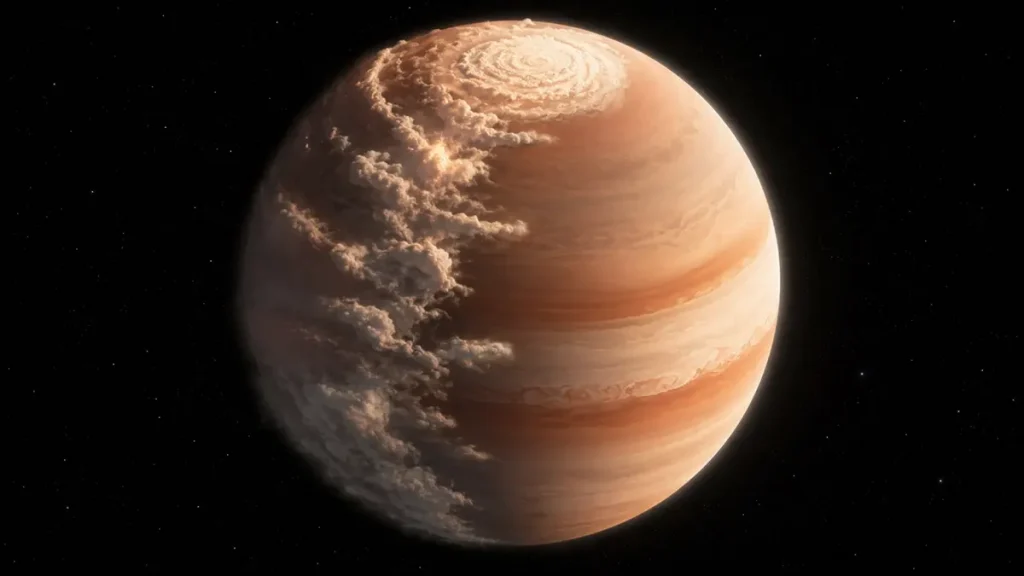
The simplest explanation starts with heat flow. Air moves around the planet from colder regions to hotter ones. As that air crosses the nightside, it cools enough for clouds to condense. By the time it reaches the morning side of the dayside, those clouds can still be hanging in the atmosphere.
These clouds are not water clouds like the ones on Earth. On a hot Jupiter, the temperatures are so extreme that cloud particles can contain mineral material. Scientists think WASP-94A b may host clouds made of magnesium silicates, iron, and magnesium sulfide. That is rock vapor turned into weather.
When sunlight reaches the morning side, the clouds begin to break apart. The rise in temperature pushes material back into vapor form. So the dayside does not stay cloudy for long. The result is an atmosphere that looks cloudy in one region and clearer in another, all on the same world.
Night-side cooling builds the clouds
At night, the atmosphere cools enough for condensed particles to form. The colder gas can no longer hold some materials in vapor form. That shift creates clouds that build up before dawn on the side moving into sunlight.
Morning sunlight clears the dayside
Once the cloud-bearing air reaches the brighter side, heating becomes strong enough to erase much of the cloud cover. The result is a clearer evening edge and a cloudier morning edge, which is exactly the kind of split JWST picked out.
Expert tip
On hot Jupiters, clouds can hide the very molecules astronomers want to measure, so weather patterns matter as much as chemistry.
What This Means for Exoplanet Science
This result matters because it shows that atmospheres on other planets are not uniform. That may sound obvious, but it is easy to forget when all you have is a single spectrum. A planet can look chemically simple if you average over regions that are actually very different.
The planet 700 light years away with sand clouds is a good warning against oversimplified models. If one side is cloudy and another is clearer, then a single global interpretation can lead to the wrong answer. The data may be correct, but the model used to explain it may not be.
That is one reason exoplanet science has become more careful over time. Researchers now treat clouds, winds, and temperature structure as part of the measurement problem. They are not side details. They shape the signal itself and can change what astronomers think they know about an atmosphere.
How Scientists Found the Pattern
The key was to study the planet during transit and compare different atmospheric regions. As WASP-94A b crossed in front of its star, JWST detected how the starlight changed at different wavelengths. Those changes carry clues about molecules, particles, and cloud opacity.
Researchers then compared what they saw on the morning side with what they saw on the evening side. The difference was large enough to stand out clearly. That is important because it means the cloud asymmetry is not a small correction. It is a dominant feature of the atmosphere.
This kind of analysis takes careful interpretation. A spectrum is not just a simple list of ingredients. It is the result of light passing through a moving, layered, changing atmosphere. The planet 700 light years away with sand clouds gives scientists a cleaner look at that complexity than they had before.



Why Hot Jupiters Matter So Much
Hot Jupiters are useful because they are large, bright in infrared, and often orbit close to their stars. Those traits make them easier to study than smaller planets. They also live in extreme environments, which lets scientists test atmospheric physics under conditions far outside the range of Earth.
That makes them valuable laboratories. They help researchers understand circulation, cloud chemistry, and heat transport in atmospheres that are not simple or gentle. The physics still follows the same laws. The ingredients are just much harsher than anything in our own solar system.
WASP-94A b joins a growing list of hot Jupiters that JWST has studied for atmospheric structure. Each one adds another comparison point. Together, they help show which patterns are common and which are unusual. That is how a strange planet becomes a useful one.
Why This Looks More Like Real Weather Than a Static Atmosphere
When people hear the word “weather,” they usually think of Earth. But weather is really just the movement of heat, air, and condensed material through an atmosphere. By that definition, WASP-94A b absolutely has weather, even if its ingredients are extreme.
The cloud pattern on the planet 700 light years away with sand clouds is a good example. Air moves from night to day. Clouds form when the gas cools. They vanish when the gas heats up again. That sequence is simple physics, not mystery, and JWST is finally good enough to see it in detail.
That is what makes the result useful. It shows that exoplanet atmospheres are active systems, not frozen shells. They respond to irradiation, circulation, and chemistry in ways that can be measured if the telescope is sensitive enough.
What Astronomers Will Want to Do Next
The next step is to compare this planet with others that have similar heating and wind patterns. Astronomers want to know whether cloud asymmetry is common on hot Jupiters or whether WASP-94A b is especially clear in the data. Both answers would matter.
They also want better models. A good model must include temperature differences, moving air, and cloud formation at different longitudes. If a model assumes the whole atmosphere is the same everywhere, it may give a neat answer that is physically wrong.
That is why this study is more than a weather report. It is a reminder that interpretation matters as much as detection. The planet 700 light years away with sand clouds teaches us that the atmosphere itself can change what we think we see.
Why This Story Deserves Attention
This is the kind of discovery that sounds playful at first and becomes serious fast. A planet with mineral clouds and a split-day atmosphere is odd, but the underlying lesson is practical. If you want to understand a planet, you have to understand how its atmosphere behaves in space and time.
JWST is now giving scientists that chance. It can detect subtle changes that older instruments could not separate cleanly. It can help distinguish chemistry from cloud cover and local weather from global averages. That makes the telescope less like a camera and more like a physical probe of remote air.
The deeper point is simple. The universe does not need to be Earth-like to be understandable. It only needs to obey the same laws. The planet 700 light years away with sand clouds does exactly that, and that is why the finding matters.
Source: Science journal study on JWST observations of WASP-94A b; NASA James Webb Space Telescope mission data; reporting based on research led by Sagnick Mukherjee and colleagues at Arizona State University.