
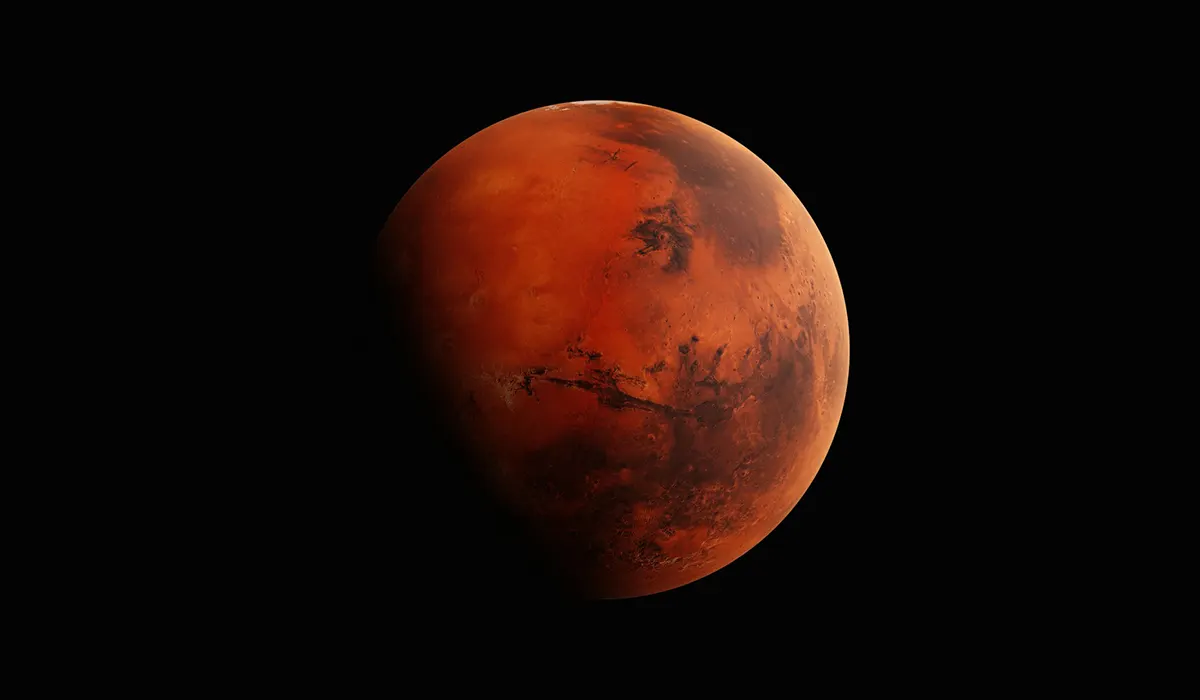
Mars did not just serve as a waypoint for NASA Psyche Mars flyby success. It acted like a precise orbital machine, giving the spacecraft the exact push it needed without burning extra propellant, which is the kind of maneuver that quietly defines deep-space mission design.
- What the Mars Flyby Actually Proved
- Why the Encounter Matters for the Asteroid Mission
- What the Cameras Saw Near Mars
- How Other Mars Missions Helped
- What the Magnetometers and Spectrometer Were Testing
- Why Gravity Assists Still Matter in the Solar-Electric Age
- What Happens Next on the Way to Psyche
- A Mission Built on Careful Measurement
- FAQ: NASA Psyche Mars Flyby Success
What makes this pass notable is not drama, but efficiency. Psyche skimmed just 2,864 miles above Mars, used gravity to change speed and trajectory, and then came out of the encounter on target for an arrival at the asteroid Psyche in August 2029.
The flyby also mattered because it gave the mission team a real-world test of systems that will have to work far from Earth, where mistakes are expensive and repair is impossible. That includes navigation, imaging, magnetometry, and the gamma-ray and neutron spectrometer, all while the spacecraft raced past a planet that can test even mature flight software.
What the Mars Flyby Actually Proved
The basic physics of a gravity assist is straightforward, even if the execution is not. A spacecraft steals a tiny amount of orbital energy and momentum from a planet moving around the Sun, and the effect shows up as a changed heliocentric speed and direction.
In Psyche’s case, the Mars flyby delivered about a 1,000 mile-per-hour boost and shifted the spacecraft’s orbital plane by roughly relative to the Sun. That plane change matters just as much as the speed increase, because the mission must reach an asteroid in the main belt with a very specific geometry.
This is why mission teams plan such flybys years in advance. A propulsive plane change at interplanetary speed would demand far more fuel than Psyche carries, especially after launch on a solar-electric spacecraft already built around careful energy management. Gravity did the work instead.
The confirmation came not from a dramatic image or a single headline figure, but from radio tracking through NASA’s Deep Space Network. Engineers monitored the Doppler shift in real time, then checked the post-flyby data to make sure the spacecraft stayed on the expected path.
That is the quiet strength of the NASA Psyche Mars flyby success story. The flyby was not about proving the spacecraft could take pretty pictures, although it did. It was about proving the mission’s navigation model matched the real solar system closely enough to trust the next four years of flight.
Why the Encounter Matters for the Asteroid Mission
Psyche is headed for a metal-rich asteroid about 173 miles, or 280 kilometers, across at its widest point. If the object really is the exposed core of a differentiated planetesimal, then it could tell us something unusual about how rocky worlds form and separate into layers.
That is a big “if,” and the mission team knows it. The asteroid may look metallic because of its composition, or because of a more complex history involving impact processing and mixing. The spacecraft’s job is to measure what is actually there, not to defend an appealing theory.
The Mars flyby therefore served as both transit and trial run. The spacecraft is not only traveling toward Psyche; it is also rehearsing the exact kinds of observations it will need once it enters orbit. That is where careful calibration becomes as important as raw instrument capability.
The imagers were powered up for calibration, along with the magnetometers and the gamma-ray and neutron spectrometer. Those instruments each probe a different layer of physical reality: reflected light, magnetic environment, and elemental signatures from the asteroid’s surface.
Expert tip:
A gravity assist does not “push” a spacecraft like a rocket; it changes the spacecraft’s motion by trading a tiny amount of orbital energy with the planet.
What the Cameras Saw Near Mars
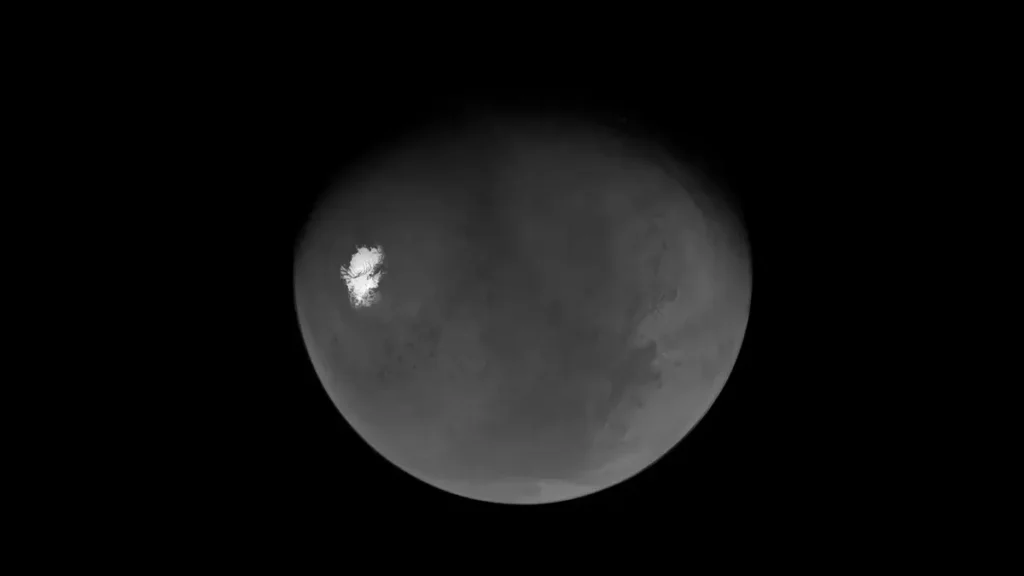
Psyche approached Mars at a high phase angle, which means the spacecraft, Mars, and the Sun were arranged so that the planet appeared as a thin crescent. That geometry is useful because it stresses imaging systems in ways a full-disk view does not.
The crescent came out brighter and stretched farther around the planet than expected, mainly because sunlight scattered through Mars’ dusty atmosphere. That is not a flaw in the camera; it is a reminder that red planets still have real atmospheres, and dust changes the optical response in measurable ways.
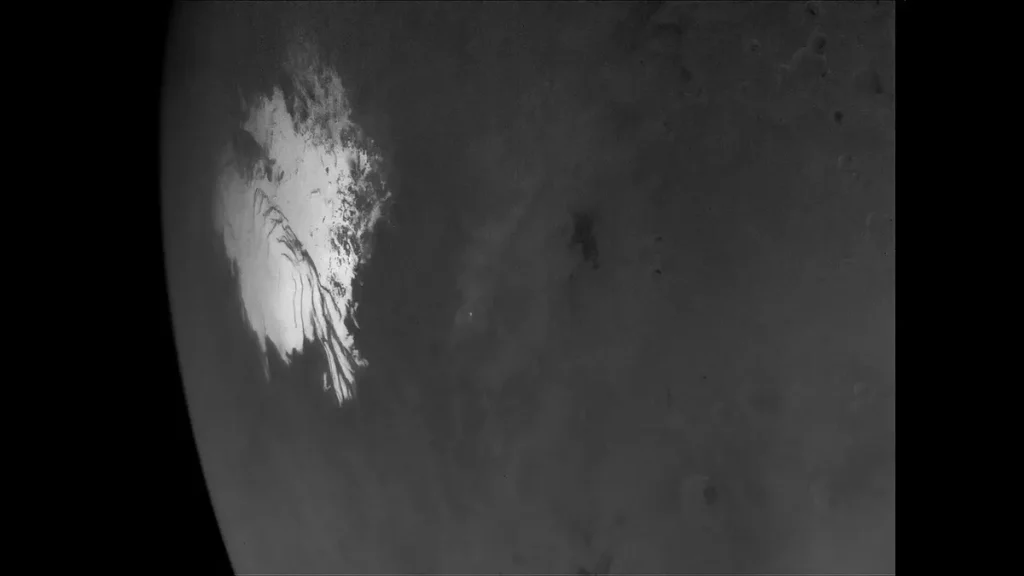
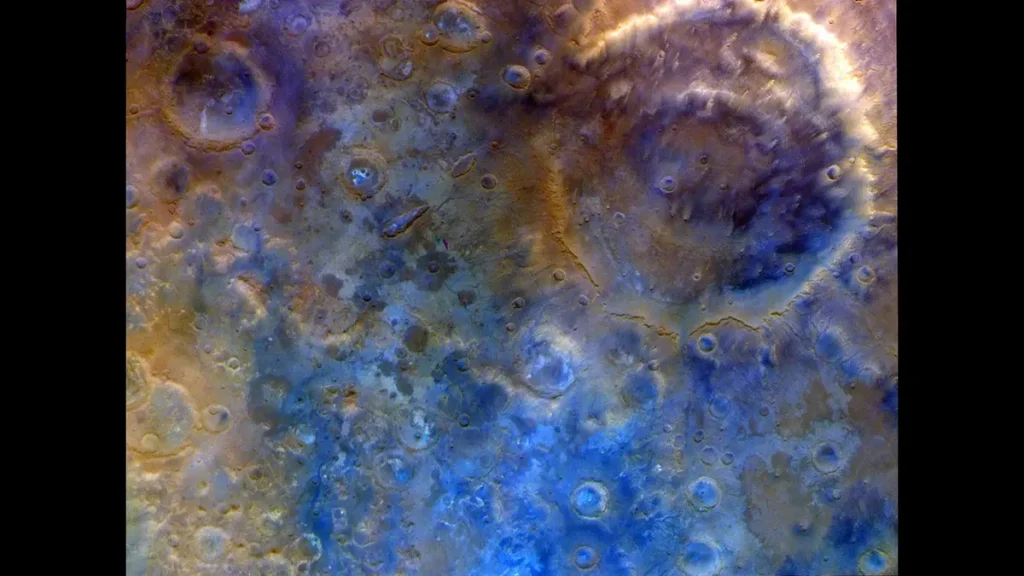
The spacecraft also captured rapid sequences of the surface as it moved from Mars’ night side into daylight. Those images help the team test exposure control, image processing, timing, and calibration routines before the asteroid campaign begins in earnest.
Jim Bell, who leads the imager instrument effort, said the team collected thousands of images during the approach and close pass. That number matters less as a headline than as a calibration dataset, because instrument models only improve when engineers can compare predictions against a large spread of real observations.
The NASA Psyche Mars flyby success was especially useful here because Mars has already been studied by many missions. That gives the team a rich comparison set, which makes it easier to separate camera behavior from planetary effects.
How Other Mars Missions Helped
Psyche was not flying blind through the encounter. Several missions already at Mars provided supporting data, including Mars Reconnaissance Orbiter, Mars Odyssey, Curiosity, Mars Express, ExoMars Trace Gas Orbiter, and the Perseverance rover team through Mastcam-Z.
This kind of cross-mission cooperation is easy to overlook, but it is central to modern planetary science. A flyby spacecraft sees one version of Mars from one geometry, while orbiters and rovers provide different references for surface brightness, atmospheric scattering, and timing.
That matters because calibration is not just about whether a camera works. It is about knowing how to turn raw pixel values into physical measurements that mean something, whether that is surface reflectance, atmospheric haze, or instrument drift over time.
There is also a practical operational benefit. When one spacecraft passes a target at unusual geometry, other active Mars missions can help interpret what the flyby saw and spot discrepancies in timing, pointing, or image formation. That tightens the chain from observation to interpretation.
This is one of the more useful parts of the NASA Psyche Mars flyby success story: the mission did not simply use Mars as a gravity source. It used the whole Mars system, with its fleet of orbiters and surface assets, as a calibration laboratory.
What the Magnetometers and Spectrometer Were Testing
Psyche’s magnetometers may have detected Mars’ bow shock, the region where the solar wind slows and deflects before interacting with the planet’s induced magnetic environment. If that signal holds up in analysis, it gives the team another valuable check on instrument behavior.
For a mission aimed at a potentially metallic asteroid, magnetic measurements matter a great deal. They can help constrain whether the body has remanent magnetization, what its internal structure might be, and how its surface interacts with the space environment.
The gamma-ray and neutron spectrometer also took advantage of the flyby to gather calibration data. That instrument works by measuring particles and radiation produced when cosmic rays strike the surface, which can reveal elemental composition over time.
Mars is particularly useful for calibration because we already have a large body of measurements from prior missions. That lets scientists compare Psyche’s readings against known patterns and check whether the detector response matches expectations.
None of this guarantees what the asteroid will show. It only means the instruments are being tuned against a real, scientifically rich target before the mission reaches the object that matters most. That is exactly how you build confidence in deep-space measurements.
Why Gravity Assists Still Matter in the Solar-Electric Age
It is tempting to think that modern propulsion makes gravity assists less important, but that would be the wrong lesson. Solar-electric propulsion offers efficient low-thrust acceleration over long periods, yet it still benefits enormously from planetary assists.
A gravity assist gives a mission free directional and energy changes without spending propellant, which matters because every kilogram saved can be used for science margin, trajectory flexibility, or mission longevity. In interplanetary flight, that kind of saving is hard to beat.
Psyche is a good example of how old and new propulsion logic work together. Solar-electric thrust handles the gradual reshaping of the trajectory, while Mars supplies the mechanical nudge that would otherwise require a costly engine burn.
That combination is also a reminder that spaceflight is often less about brute force than about timing. The spacecraft, the planet, and the Sun all have to be in the right configuration, and that requires years of planning followed by close tracking during execution.
For readers following NASA Psyche Mars flyby success, the key point is that the flyby was not a side event. It was a structural part of the mission architecture, built into the route from launch to asteroid arrival.
What Happens Next on the Way to Psyche
With Mars behind it, the spacecraft will resume using its solar-electric propulsion system for the long cruise to the main asteroid belt. That thrust is gentle by terrestrial standards, but in space it adds up over months and years with impressive efficiency.
The mission plans to arrive at the asteroid in August 2029 and enter orbit around it. From there, Psyche will move through a series of circular orbits, first lower and then higher, so the team can map the asteroid from different distances and angles.
That orbital sequence matters because a small body like Psyche has weak gravity and an irregular field. Mission planners have to use careful orbit design to balance mapping resolution, fuel use, and dynamical stability.
If the asteroid is indeed a preserved core or core fragment, then the measurements could help scientists test models of how early planetesimals melted, differentiated, and sometimes lost their mantles through violent collisions. That is where the science becomes truly interesting, because the body would become a rare sample of interior planetary material seen from orbit.
Still, caution is essential. The asteroid’s true nature remains uncertain until the data come in. The mission can test hypotheses, but it cannot assume the answer in advance.
A Mission Built on Careful Measurement
The strongest part of this flyby is not the headline number for speed gain or the beauty of the Mars images. It is the way the entire mission system held together under real flight conditions, from navigation and DSN tracking to instrument calibration and image processing.
That is what makes deep-space missions scientifically durable. They succeed when each subsystem confirms the others, and when the observed data line up closely enough with preflight models to keep the trajectory, the instruments, and the science plan intact.
Mars served as a practical testbed, a gravitational tool, and a calibration target all at once. Psyche used the encounter well, and the mission now moves toward a far more important test: whether the asteroid itself really preserves clues about the guts of rocky worlds.
For now, the NASA Psyche Mars flyby success tells us something simple but important: the mission team got the geometry right, the spacecraft behaved as intended, and the next phase of the journey remains on schedule for the asteroid Psyche in 2029.
FAQ: NASA Psyche Mars Flyby Success
What did Psyche gain from the Mars flyby?
It gained a velocity increase of about 1,000 miles per hour and a plane change of roughly relative to the Sun, both achieved without using onboard propellant.
Why was Mars needed at all?
Mars provided a gravity assist that helped send Psyche toward the asteroid belt more efficiently than propulsion alone could have done.
Did the flyby help with science, not just navigation?
Yes. The spacecraft used the encounter to calibrate its cameras, magnetometers, and gamma-ray and neutron spectrometer, while also collecting Mars imagery and test data.
When will Psyche reach its asteroid target?
The spacecraft is expected to arrive at the asteroid Psyche in August 2029.
Why is asteroid Psyche scientifically interesting?
It may be a partial metallic core of an ancient planetesimal, which could help scientists study the interior structure of rocky bodies like Earth.
Source: NASA Psyche mission news release, May 2026, and mission background from NASA Science / JPL.