
A black hole sounds like the last place you would put a planet nursery. Yet new modeling suggests millions of exoplanets near black holes could form inside the outer regions of active galactic nuclei, where gas and dust circle supermassive black holes on galactic scales.
- Why Millions of Exoplanets Near Black Holes Sounds Wrong at First
- What the New Model Actually Claims
- How Streaming Instability Could Build Planets in AGN Disks
- What These Black Hole Planets Might Look Like
- Why These Planets May Migrate Away From the Black Hole
- The Evidence Chain Behind Millions of Exoplanets Near Black Holes
- How We Might Detect Planets Around Supermassive Black Holes
- Why This Could Change How We Think About Planet Formation
- What Scientists Still Need to Prove
- FAQ
- Did scientists actually detect planets near black holes?
- How can planets form near something as destructive as a black hole?
- Would these planets orbit the black hole instead of a star?
- Could these planets support life?
- Why do researchers think there could be millions?
- What This Idea Really Changes
That claim feels wrong at first, and honestly, it should. Active galactic nuclei can outshine all the stars in their host galaxies. They produce radiation, plasma jets, shocks, and violent disk motion that would make any calm planet-forming picture look naïve.
But the key detail sits far from the event horizon. The researchers did not place planets beside the black hole’s edge. They studied the colder, dust-rich outskirts of the accretion disk, tens of parsecs away, where physics may become unexpectedly familiar.
Why Millions of Exoplanets Near Black Holes Sounds Wrong at First
When most people picture planets forming, they picture a young star wrapped in a rotating disk of gas and dust. That picture works because astronomers have observed such disks around infant stars, and because our own solar system still carries the chemical memory of that early disk.
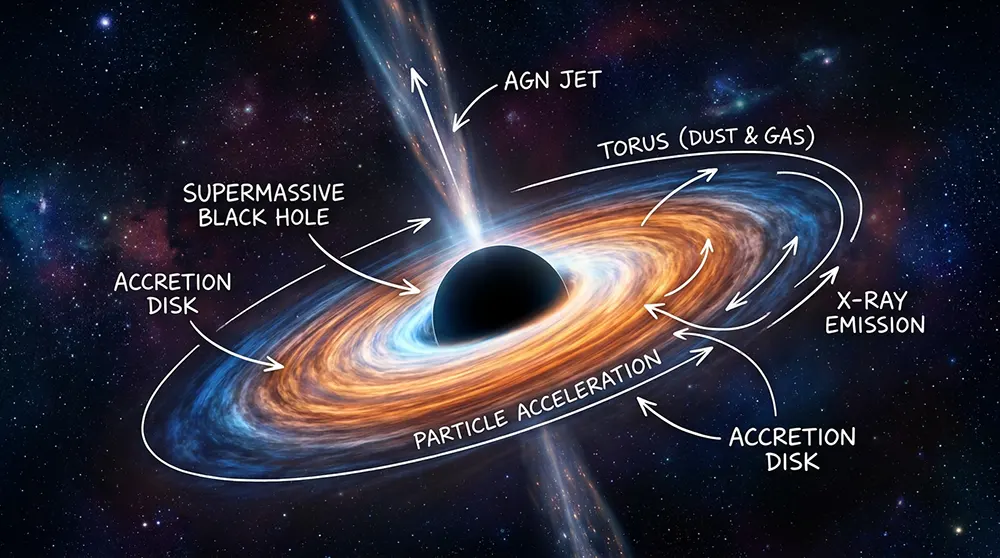
A supermassive black hole seems like the opposite setting. In an active galactic nucleus, matter falls into a deep gravitational well and heats up as friction, magnetic stress, and orbital shear convert motion into radiation. The inner disk becomes bright enough to dominate a whole galaxy’s light.
So yes, I’m going to argue that planets may form there, but the counterargument deserves respect. Strong radiation can heat dust, break molecules apart, stir gas, and prevent small grains from settling. Planet formation needs local order, and AGN disks do not look orderly at first glance.
The new idea matters because it does not ignore that hostile environment. It moves the question outward. Instead of asking whether planets can grow near the central black hole, it asks whether the outer accretion disk can create dense dust filaments like young stellar disks sometimes do.
What the New Model Actually Claims
The research, led by Bhupendra Mishra with Wladimir Lyra among the collaborators, uses a model of a supermassive black hole accretion disk and focuses on conditions near its outer edge. That distinction carries most of the scientific weight in this story.
According to Mishra’s comments to Space.com, the team found that millions of Jupiter-mass planets could form tens of parsecs from supermassive black holes. One parsec equals about 3.26 light-years, so these objects would sit far beyond the scale of ordinary planetary systems.
These would not resemble Earth, Mars, or even ordinary gas giants in a familiar solar-system arrangement. Mishra described them as dust giants exceeding Jupiter’s mass, possibly appearing like lava balls. That image sounds dramatic, but the physics behind it stays more interesting than the label.
The phrase “millions of exoplanets near black holes” needs careful handling. These objects would qualify as planets in the broad sense that they form from disk material and reach planetary masses. Yet they would not orbit a star; their central gravitational anchor would be a supermassive black hole.
The Important Region Is Not Near the Event Horizon
If you are imagining a planet skimming the edge of a black hole shadow, stop there for a second. The model does not require that. Tens of parsecs place these potential planets in the extended outskirts of the AGN disk, not beside the event horizon.
That distance changes almost everything. Radiation from the inner disk still matters, but gas temperature, dust survival, orbital time, and disk thickness can differ strongly from the inner accretion flow. In astrophysics, “near a black hole” can still mean light-years away.
This scale also explains why the comparison to protoplanetary disks around young stars enters the discussion. The outer AGN disk may contain enough dust and gas at suitable temperatures for clumping to begin. The mechanism does not need a quiet nursery, only the right local conditions.
Picture dust collecting under a bed, not because the room stays perfectly still, but because airflow, corners, and surfaces create places where particles gather. Astrophysical disks behave with far more math, of course, but the habit of matter concentrating in favored zones feels oddly familiar.
How Streaming Instability Could Build Planets in AGN Disks
The central mechanism in the model is streaming instability. In simple terms, dust grains moving through gas do not behave like isolated pellets. Gas drag changes their motion, dust back-reacts on the gas, and under the right conditions, dense strands of solids can form.
Those strands matter because planet formation has a famous bottleneck. Tiny dust grains stick by contact forces, but larger pebbles and boulders often bounce, drift inward, or break apart. Streaming instability offers a way around that problem by concentrating solids quickly enough for gravity to help.
Once a dense filament forms, self-gravity can pull material together into planetesimals, the larger building blocks of planets. Around young stars, this process helps explain how small solids can grow into kilometer-scale bodies before disk drift removes them. The AGN model borrows that tested physical idea.
Here is the key difference: an AGN disk can contain far more gas and dust than a young star’s disk. That larger reservoir changes the possible yield. Around a star, planet formation may produce several planets. Around a supermassive black hole, the model allows far larger numbers.
Why Gas-Rich Disks Change the Math
Mass matters. A disk around a newborn star contains a fraction of the star’s mass, and it thins out over a few million years. An AGN disk can spread across far larger distances and hold enough material to change the statistics of dust concentration.
That does not mean every AGN makes planets, or that the model has proven these planets exist. It means the team found a plausible route under the conditions they tested. In science, that step counts as an opening constraint, not a finished detection.
The researchers’ strongest point sits here: they used a known planet-formation mechanism in a setting where many people would not expect it to operate. The result is significant less because it sounds unusual than because it asks whether planet formation depends more on local disk physics than on the identity of the central object.
What These Black Hole Planets Might Look Like
The modeled planets would likely differ strongly from Jupiter, despite their similar or larger masses. Jupiter formed in a young solar disk rich in hydrogen, helium, ices, rock, and complex chemistry. AGN disk planets may form from dust-rich material under stronger irradiation and stranger thermal conditions.
Mishra’s “lava balls” description gives readers a useful mental picture, but we should not treat it as a telescope image. It reflects expected heat and composition, not direct observation. No one has photographed these objects, measured their spectra, or tracked their orbits.
Their surfaces, if they have meaningful surfaces, may remain extremely hot. Their atmospheres could depend on local gas chemistry, radiation exposure, and formation speed. Their mass range may also blur the boundary between giant planets, brown-dwarf-like objects, and compact clumps formed in disk gas.
That boundary will matter later. Astronomers do not classify objects only by mass; they also ask how they formed. A body above Jupiter’s mass can still form like a planet, while another similar object may form through direct gravitational collapse. Formation history carries the label.
Why These Planets May Migrate Away From the Black Hole
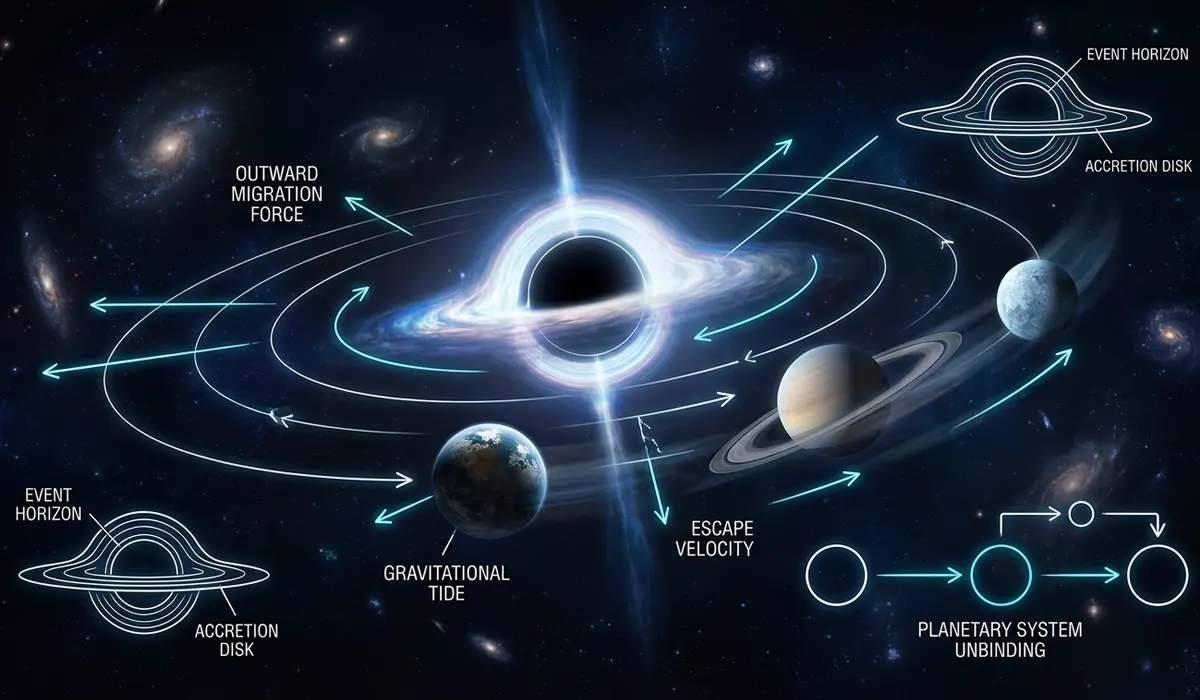
The same disk that helps planets form can also push them around. In ordinary protoplanetary disks, young planets exchange angular momentum with gas. That interaction can move them inward or outward, depending on disk structure, temperature gradients, pressure, and the planet’s mass.
The AGN model suggests these black hole planets may migrate radially away from the supermassive black hole and the outer disk edge. That detail matters because survival does not mean staying put. A stable planet can still move through a disk over long periods.
Migration also changes detectability. If planets spread outward from their birth zones, they may form a broad population rather than a compact ring. Such a population could affect disk structure, dust distribution, and possibly the way background light bends or flickers through gravitational lensing.
This is where the story stops sounding like a novelty and starts sounding like disk physics. The same concepts that shape hot Jupiters around stars may also apply, in altered form, around black holes. The central object changes, but gravity and gas drag still keep accounts.
The Evidence Chain Behind Millions of Exoplanets Near Black Holes
A model becomes useful when it tells us what assumptions drive the result. Here, the claim depends on disk conditions at large radius, dust-to-gas behavior, streaming instability thresholds, and migration. If any of those inputs shift strongly, the predicted planet population could change.
The evidence chain looks like this:
- Active galactic nuclei contain large disks of gas and dust around supermassive black holes.
- Outer disk regions may become cool and dense enough for dust concentration.
- Streaming instability can gather solids into planet-forming filaments.
- The model predicts many Jupiter-mass dust giants that later migrate outward.
That chain is physically coherent, but it is not the same as observation. The team has produced a theoretical result, now shared as a preprint on arXiv. Readers should treat it as a serious model proposal that still needs peer review, testing, and independent checks.
Expert Note: The Real Surprise Is the Location
The surprising part is not that dust can build planets; it is that an AGN disk’s outer edge may give dust enough time and mass to do it at huge scale.
How We Might Detect Planets Around Supermassive Black Holes
Finding these objects would not be easy. A planet tens of parsecs from a bright galactic nucleus would not stand out like a familiar exoplanet crossing a star. The background glare, distance, and crowding near galactic centers all work against direct detection.
Mishra pointed to gravitational lensing as one possible route. Massive objects bend and magnify light from background sources. If a cluster or population of these planets sits in the outskirts of an AGN disk, it might leave a lensing signal under fortunate alignment conditions.
The word “fortunate” matters. Gravitational lensing requires geometry. A foreground mass must pass close enough to a background light source from our point of view. Astronomers cannot arrange that setup; they monitor the sky and wait for nature to hand them clean alignments.
Even then, separating planets from stars, brown dwarfs, gas clumps, or disk substructure would take careful modeling. A lensing signal rarely arrives with a label attached. Researchers would need repeat patterns, mass estimates, spatial context, and consistency with AGN disk predictions.
Why This Could Change How We Think About Planet Formation
The deeper question is not whether black holes make strange planets. The deeper question asks what planet formation really needs. If planets can form in AGN disks, then the process may depend less on stars than on rotating gas, dust, cooling, and gravity.
That idea has precedent. Astronomers already know that disks appear in many settings: young stars, compact binaries, black holes, and galaxies. Disks form because angular momentum resists direct collapse. Material spreads, heats, cools, clumps, and transports angular momentum through physical processes we can model.
Planet formation may therefore sit inside a wider family of disk behavior. The Sun gave us our local example, but it may not define the full range. If the model survives testing, AGN disks could become an extreme laboratory for the same basic physics.
Still, I would not call this settled. The result depends on conditions in outer AGN disks, and astronomers do not understand those regions as well as stellar protoplanetary disks. Data remain sparse, and models must fill gaps with assumptions that future observations may revise.
What Scientists Still Need to Prove
The next step is not a better headline. It is better physics and better observation. Researchers need to test how sensitive the predicted planet formation is to disk temperature, turbulence, radiation pressure, dust growth, opacity, magnetic fields, and the lifetime of the AGN phase.
They also need to compare this model with other possible structures in outer AGN disks. Dense clumps might form, but do they always become planets? Could fragmentation produce star-like objects instead? Could feedback from the central engine remove dust before streaming instability takes hold?
That kind of caution does not weaken the study. It makes the study more useful. A good theoretical paper should give other researchers something to attack, refine, or observe. If a model cannot fail, it cannot teach us much about nature.
The best version of this result will come from independent simulations using different assumptions, followed by observational searches for lensing signatures or disk features. If those tests line up, the phrase “millions of exoplanets near black holes” will move from possibility toward evidence.
FAQ
Did scientists actually detect planets near black holes?
No. The current claim comes from computer modeling, not direct detection. The team found that planets could form in the outer regions of AGN accretion disks under certain conditions. Observation, especially through gravitational lensing, would provide a stronger test of the idea.
How can planets form near something as destructive as a black hole?
The planets in this model do not form near the event horizon. They form tens of parsecs away, in the outer disk around a supermassive black hole. At those distances, dust and gas may cool enough for streaming instability to gather solids into growing bodies.
Would these planets orbit the black hole instead of a star?
Yes, if they exist as modeled, their main gravitational anchor would be the supermassive black hole and the surrounding disk environment. That makes them very different from familiar exoplanets, which usually orbit stars and reveal themselves through starlight changes.
Could these planets support life?
The current model does not suggest habitable worlds. These objects may be hot, massive, dust-rich giants exposed to AGN radiation and unusual disk chemistry. Life requires stable conditions, suitable chemistry, and energy balance, none of which the study claims for these planets.
Why do researchers think there could be millions?
The number comes from the scale and mass of AGN disks. Compared with disks around young stars, AGN disks can contain far more gas and dust across much larger distances. Under the modeled conditions, that reservoir could support many Jupiter-mass planet-forming sites.
What This Idea Really Changes
The study does not prove that black holes host planet swarms. It shows that a known route to planet formation may operate in a place many astronomers would not pick first. That alone makes the model worth taking seriously.
If future observations confirm even part of this prediction, planet formation will look less like a star-specific story and more like a general outcome of dusty disks. The search for millions of exoplanets near black holes has only just gained a physical map.
Source: Space.com reporting on Bhupendra Mishra and collaborators; arXiv preprint on planet formation through streaming instability in active galactic nucleus disks.