

You ever wonder how your brain manages to keep all its parts talking to each other at the same time? It’s not just random chatter. Imagine a crowd doing the wave at a stadium—but inside your head. Scientists have uncovered that waves of brain activity don’t just move in straight lines; they actually rotate, sweeping across the brain in a mesmerizing circular dance. This discovery flips some old ideas and opens a whole new way to think about how our brains coordinate complex tasks.
- The Hidden Pattern of Rotating Waves in the Brain
- Mirroring Waves Across Brain Hemispheres
- Subcortical Connections: Beyond the Brain’s Surface
- Behavior and Brain State: When Do These Waves Matter?
- Why Rotating Waves Matter: A New Way to Understand Brain Coordination
- What This Means for Future Research and You
- The Brain’s Rotating Waves: A New Beat for Understanding Coordination
What’s wild is that these rotating waves aren’t isolated to one spot. They ripple across both sides of the brain, linking sensory and motor areas like a perfectly synchronized duet. And they don’t just stop at the surface—they reach deep into subcortical regions, pulling in parts of the brain involved in movement and sensation. It’s like the brain’s own version of a well-rehearsed orchestra, with waves as the conductor’s baton.
The Hidden Pattern of Rotating Waves in the Brain
When you picture brain waves, you might think of simple back-and-forth rhythms or pulses traveling in a straight line. But recent research reveals something far more complex and elegant: rotating waves. These waves spin around a central point, mainly in the somatosensory cortex—the brain’s map of touch and body sensation.
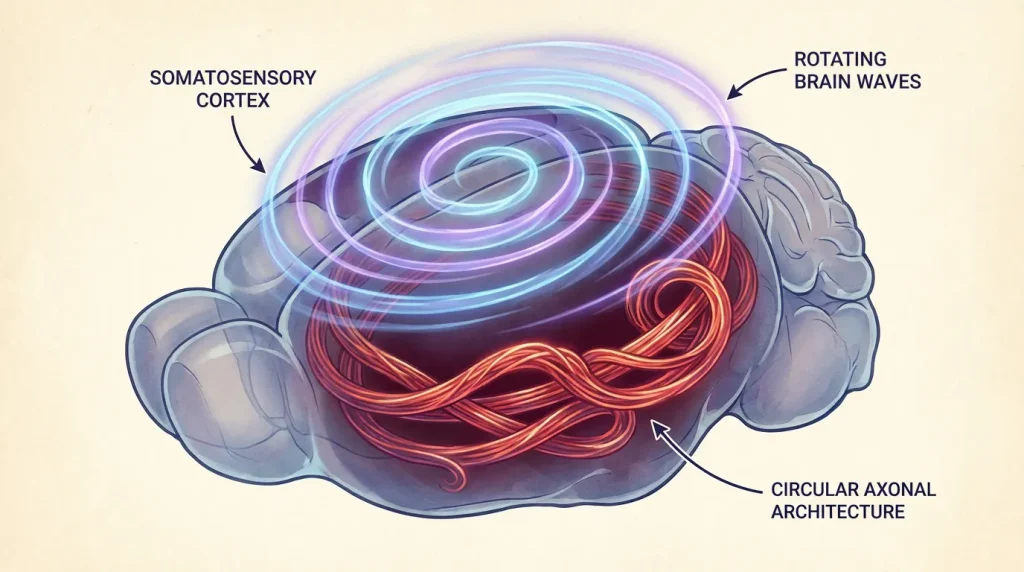
These waves don’t just randomly appear. They follow the brain’s physical wiring, which itself is arranged in a circular pattern in this area. This isn’t coincidence. The local neurons’ axons (think of them as the brain’s wiring cables) are laid out in loops that support this spinning activity. It’s a bit like the grooves on a vinyl record guiding the needle’s path.
Using wide-field calcium imaging, scientists watched these waves sweep across the mouse cortex. The waves moved in a circular path, crossing over the brain’s somatotopic maps—the regions that correspond to specific parts of the body. This means the wave’s movement mirrors how the brain represents the body, suggesting a link between physical wiring and brain activity patterns.
Mirroring Waves Across Brain Hemispheres
Here’s a twist: the rotating waves don’t just stay on one side of the brain. They appear almost like mirror images in the left and right hemispheres. This bilateral symmetry hints that the brain’s long-range connections are finely tuned to coordinate activity across both sides.
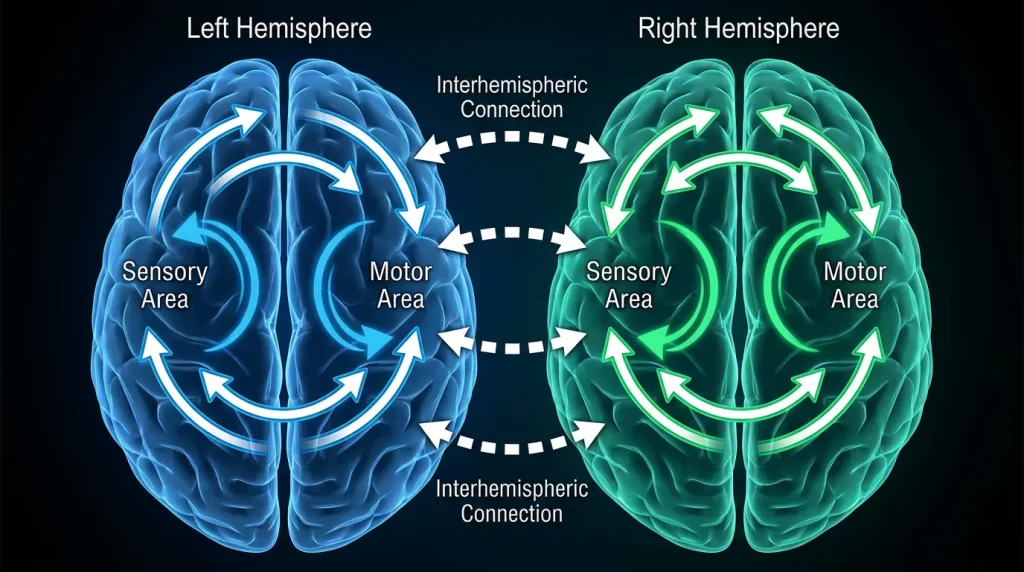
Not only that, but these waves also link sensory areas with motor regions. So, when your brain processes touch or other sensory inputs, the waves help coordinate the movement response. This coordination is essential for smooth actions, like reaching out to grab a cup or reacting to a sudden touch.
Cutting the local circuits in the somatosensory cortex disrupted the waves in the motor cortex, showing these circuits are crucial for the waves’ formation and coordination. This finding nails down a mechanistic link between brain wiring and wave activity.
Subcortical Connections: Beyond the Brain’s Surface
What’s striking about these waves is their reach. They don’t just stay on the cortex’s surface but also coordinate with deeper brain regions like the thalamus, striatum, and midbrain. These areas are heavily involved in processing sensory information and controlling movement.
Electrophysiological recordings revealed that neurons in these subcortical regions fire in sync with the cortical rotating waves. This means the waves aren’t just a cortical phenomenon—they are part of a larger brain-wide system.
This coordination suggests that rotating waves help integrate sensory inputs with motor outputs, making sure the brain’s different parts work in harmony. Think of it as a conductor not only leading the orchestra on stage but also cueing the musicians backstage.
Behavior and Brain State: When Do These Waves Matter?
Rotating waves aren’t constant background noise. Their presence and strength change with what the animal is doing and its level of alertness. For example, when mice were more aroused or alert, the waves were stronger. Sensory stimuli could trigger these waves, and they were especially active when the mice performed a visual-motor task correctly.
This pattern hints that rotating waves might help the brain focus and coordinate during important tasks. They could be the neural signature of successful perception and action.
But it’s not just about being awake or asleep. The waves adapt depending on the brain state and behavior, suggesting a dynamic system that tunes itself to the brain’s ongoing needs.
Why Rotating Waves Matter: A New Way to Understand Brain Coordination
You might wonder why these rotating waves are such a big deal. After all, brain waves have been studied for decades. The new insight is that the waves’ shape and coordination are deeply tied to the brain’s wiring architecture. This means the brain’s physical layout isn’t just a passive backdrop—it actively shapes how information flows.
The fact that these waves coordinate activity across multiple brain regions and hemispheres points to a fundamental organizational principle. Rather than isolated pockets of activity, the brain works as a connected whole, with waves guiding the timing and direction of neural signals.
This could change how we understand brain functions like perception, movement, and even memory. Rotating waves might be the key to how the brain integrates information quickly and efficiently.
What This Means for Future Research and You
These findings open exciting questions. How do these waves influence learning or decision-making? Could disruptions in rotating wave coordination explain certain brain disorders? Could therapies target these waves to improve brain function?
For you, this research is a reminder that the brain is not just a collection of parts but a dynamic, interconnected system. The waves that sweep through it are more than electrical signals—they’re the rhythm of thought, sensation, and action.
Understanding brain wave coordination better may one day help us develop smarter brain-computer interfaces, improve treatments for neurological diseases, or even enhance cognitive abilities.
The Brain’s Rotating Waves: A New Beat for Understanding Coordination
Rotating waves in the brain aren’t just a fascinating curiosity—they reveal how the brain’s wiring shapes its activity patterns and behavior. These waves sweep across sensory and motor areas, linking both hemispheres and reaching deep into subcortical regions. This coordination suggests a system designed to integrate sensory inputs with motor responses efficiently.
The discovery that these waves are modulated by behavior and brain state highlights their role in real-time brain function. They’re not static phenomena but dynamic players in perception and action. This insight invites us to rethink how brain activity is organized, focusing on patterns shaped by anatomy and function.
As research continues, the brain wave coordination study promises to deepen our understanding of brain function and could inspire new ways to support brain health and performance. Next time you touch something or move your hand, remember—your brain’s waves are spinning a complex, coordinated dance behind the scenes.
What are rotating waves in the brain?
Rotating waves are patterns of brain activity that move in a circular motion, mainly centered in the somatosensory cortex, coordinating signals across different brain regions.
Why is the somatosensory cortex important for these waves?
The somatosensory cortex has a circular arrangement of neural wiring that supports the formation and propagation of rotating waves, linking body sensation with brain activity.
Do these waves affect behavior?
Yes, rotating waves change with brain states like alertness and are actively involved when animals perform tasks, suggesting they help coordinate perception and action.
Are rotating waves found only on the brain’s surface?
No, they also coordinate activity in deeper brain areas like the thalamus, striatum, and midbrain, showing brain-wide integration.
Could understanding these waves help with brain disorders?
Potentially, since disruptions in wave coordination might relate to neurological conditions, studying them could lead to new treatments.
Source: Ye et al., [Journal Article on Rotating Waves in Mouse Cortex], accessed via Science Magazine Editor’s Summary and Abstract.