
A UK-led experiment has shown that two atom interferometers can be compared in a way that removes overwhelming laser noise and recovers a hidden signal. The result is an important step for future detectors designed to search for dark matter and gravitational waves from the early universe.
In simple terms, the test shows that a quantum sensor does not need each single measurement to look clean. If two sensors share the same noise, scientists can compare them and subtract much of that noise away.
The work comes from the Atom Interferometer Observatory and Network, or AION, a collaboration led by Imperial College London. The study was published in Nature on June 17, 2026.
Why noise is the central problem
Atom interferometers measure tiny changes in the motion of atoms. They do this by using laser light to split and recombine the quantum state of ultracold atoms, creating an interference pattern that carries information about motion, gravity, or other weak effects.
That makes them attractive for fundamental physics. A passing gravitational wave, or a field associated with some dark matter models, could slightly change the relative behavior of two separated atom clouds.
The difficulty is that the same lasers needed to control the atoms also add phase noise. Phase noise means small unwanted changes in the timing or phase of the laser light. In the kind of large detectors being planned, that noise can be far larger than the signal researchers hope to see.
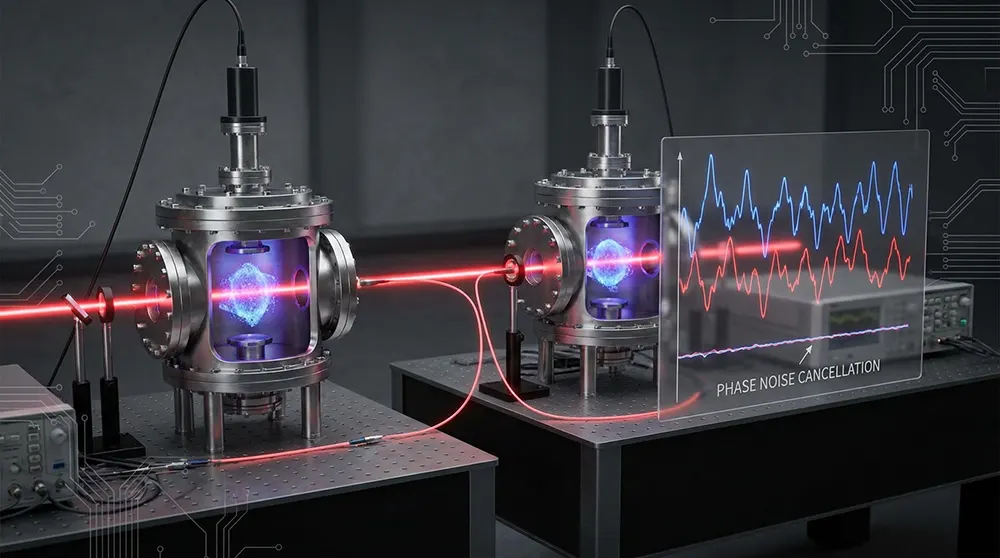
For years, proposed long-baseline atom interferometers have relied on a solution: use two atom interferometers driven by the same laser and compare their outputs. Noise common to both should cancel, while a real differential signal should remain.
Until now, that central idea had not been demonstrated under realistic experimental conditions.
What Imperial’s prototype showed
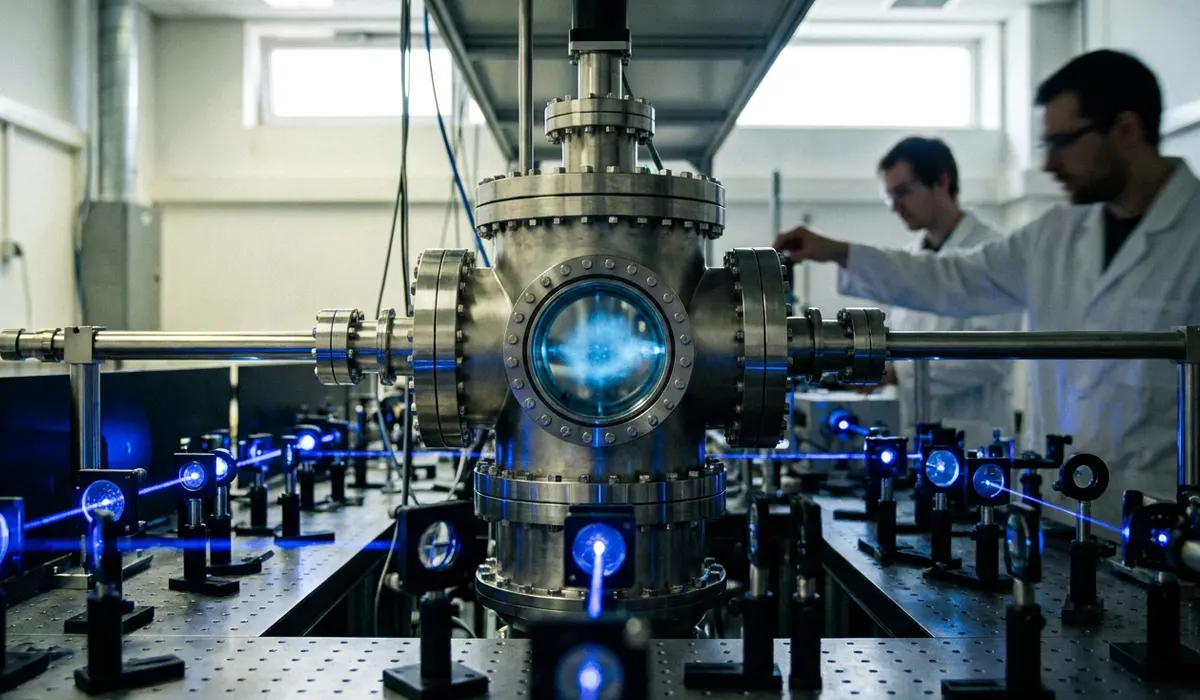
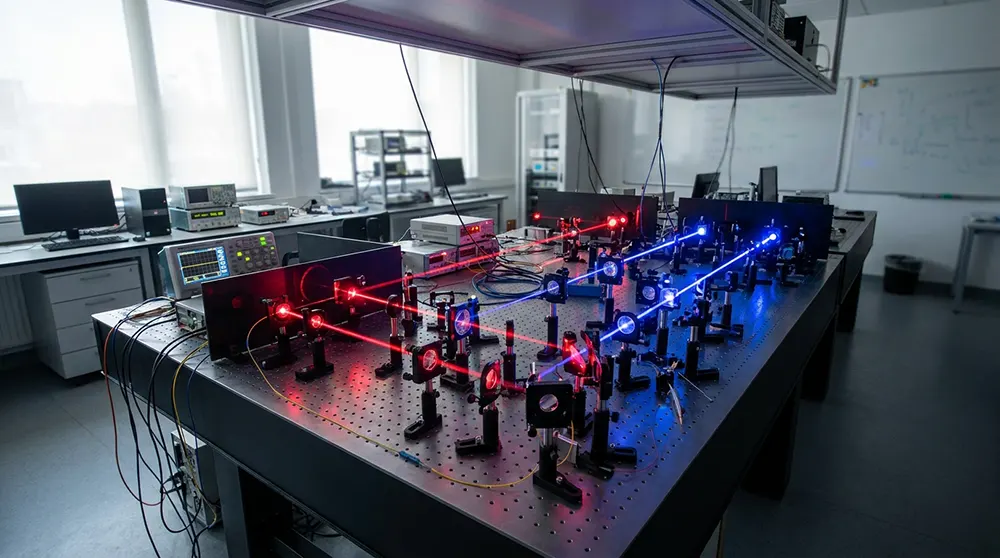
Researchers at Imperial’s Ultracold Strontium Laboratory built a tabletop test using two separated clouds of ultracold strontium-87 atoms. Both were measured with one ultrastable clock laser.
Strontium-87 is widely used in precision measurement because its atomic transitions can be controlled with very high accuracy. In this experiment, the atoms were cooled close to absolute zero, where their motion becomes slow enough for delicate quantum measurements.
To make the test demanding, the team deliberately added large amounts of extra phase noise. The added noise was much stronger than the noise normally produced by clock lasers and was intended to mimic the conditions expected in long-baseline detectors.
Measured separately, each atom interferometer appeared useless. The noise washed out the interference patterns needed for a clean reading.
The result changed when the researchers compared the two measurements. The shared laser noise largely canceled, and the underlying signal returned. According to the study summary, the combined measurement reached the fundamental limit set by quantum physics.
That point matters. It means the cancellation method was not only working in a rough engineering sense. It performed at the level needed for the physics that future detectors are designed to test.
Recovering a signal neither sensor could see alone
The team then introduced an additional oscillating signal into the system. It was not a detection of dark matter or a gravitational wave. Instead, it was a controlled test signal, similar in form to the kind of effect future instruments might seek.
Even though neither interferometer could recover that signal by itself, the differential comparison made it visible.
That is the physics value of the result. Searches for dark matter and early-universe gravitational waves are often limited less by the idea of the signal than by the practical ability to distinguish it from noise. A detector must not only be sensitive. It must also prove that its noise rejection works in the same conditions where the measurement will be made.
Dr. Charles Baynham, co-lead of the Ultracold Strontium Laboratory at Imperial College London, said the field is reaching the point where such instruments can be built with the needed resolution. “I can’t wait for the day when signals from an atom are telling us about a black hole that merged millions of years ago,” he said.
How this differs from earlier work
The new result does not claim a discovery of dark matter. It also does not report a new gravitational-wave detection.
Its importance is more technical and more specific. A key assumption behind future atom-based detectors has now been tested in a laboratory setup designed to resemble the noise conditions expected in larger instruments.
Previous proposals for detectors such as AION, MAGIS, and AICE depend on differential atom interferometry. The approach was mathematically and physically well motivated, but proposed detector designs need experimental proof that the method survives realistic noise.
This prototype provides that proof for one of the main noise problems. It shows that laser phase noise, even when made intentionally severe, can be rejected by comparing two interferometers driven by the same laser.
That does not solve every engineering problem. Larger devices will need longer baselines, stronger and more stable laser systems, careful control of atomic sources, and protection from environmental disturbances. Still, the experiment removes an important uncertainty from the design path.
A path toward larger detectors
AION is part of a wider international effort to build large-scale atom interferometers for fundamental physics. The program is linked with work on MAGIS at Fermilab and the proposed Atom Interferometry CERN Experiment, known as AICE.
Such facilities would use much longer distances than the Imperial tabletop prototype. Longer baselines generally improve sensitivity to very weak effects, but they also increase the challenge of keeping the measurement controlled.
Dr. Richard Hobson, also co-lead of the Ultracold Strontium Laboratory, said the work shows that atomic clocks and atom interferometers can be adapted for new physics searches. Scaling the experiment to facilities such as CERN or Fermilab, he said, could help address questions including “the nature of dark matter.”
Professor Oliver Buchmueller, principal investigator of the AION collaboration at Imperial, described the study as an important milestone for future large-scale quantum sensors. He said it demonstrates a key technique relevant to next-generation atom interferometer facilities now being developed internationally.
Why it matters beyond one lab test
Modern physics contains several well-defined gaps. Astronomers see the gravitational effect of dark matter, but its particle or field nature remains unknown. Gravitational waves have opened a new way to study compact objects, yet some frequency bands remain difficult to access with existing detector concepts.
Atom interferometers offer a possible route into some of those gaps. They are not replacements for all existing instruments. Their promise lies in measuring weak, slow, or oscillating effects with a different physical system: atoms whose quantum states act as highly stable references.
The Imperial result is significant because it tests a practical requirement, not just a theoretical hope. If future detectors are to listen for faint signals across long distances, they must first show that ordinary laboratory noise can be controlled well enough.
That is what this prototype has now done. It brings large-scale atom interferometer projects a step closer to becoming testable instruments for dark matter and gravitational-wave science.
FAQ
What is a quantum sensor?
A quantum sensor uses quantum properties of atoms, light, or other systems to measure very small changes in motion, fields, time, or gravity with high precision.
Did this experiment detect dark matter?
No. The team tested a method needed for future dark matter searches. They added a controlled signal to show that hidden signals can be recovered under heavy noise.
Why use two atom interferometers?
Two interferometers driven by the same laser share much of the same noise. Comparing them allows common laser noise to cancel while leaving possible differential signals.
What are gravitational waves?
Gravitational waves are ripples in spacetime caused by massive accelerating objects, such as merging black holes. Future atom interferometers may probe frequency bands that are hard to reach today.
What comes next for AION?
AION researchers are developing the technology needed for larger atom interferometer facilities. Related efforts include MAGIS at Fermilab and the proposed AICE experiment at CERN.
In Brief
- Imperial researchers tested a prototype quantum sensor using two ultracold strontium atom clouds.
- The system canceled strong laser phase noise by comparing two atom interferometers.
- A hidden oscillating signal was recovered even when each separate measurement looked unusable.
- The result supports future AION, MAGIS, and AICE-style detectors.
- Such instruments could help search for dark matter and early-universe gravitational waves.
Source
Baynham, C. F. A., Hobson, R., Buchmüller, O. et al. “A prototype differential atom interferometer for fundamental physics.” Nature 654, 622–628 (2026).