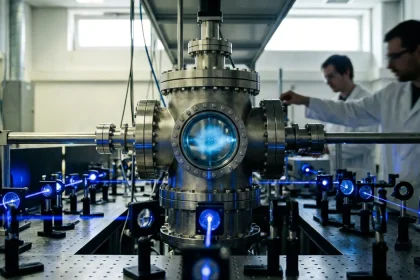


A solid can hide more motion than you expect. In a new study on anharmonic coupling in crystal lattice modes, researchers did not just infer that angular momentum moves through a crystal; they tracked it as it shifted between phonons in real time.
- Why This Result Matters More Than It First Appears
- What Anharmonic Coupling in Crystal Lattice Modes Actually Means
- Why Bi2Se3 Was a Smart Choice
- What the Theory Says, and Why It Fits the Data
- What This Does and Does Not Prove
- The Broader Lesson for Solid-State Physics
- What Comes Next for Phonon Angular Momentum Research
That matters because the old picture was always incomplete. We knew energy could flow through a lattice, and we knew momentum rules shape phonon behavior, but angular momentum inside a crystal had remained far harder to pin down.
What makes this result striking is not hype, but control. The team used terahertz light to drive one phonon in Bi2Se3 and then watched a second phonon appear with the opposite helicity, showing a direct transfer rather than a vague magnetic side effect.
Why This Result Matters More Than It First Appears
For years, angular momentum in solids was mostly treated as an inferred quantity, not something you could follow mode by mode. That gap matters because angular momentum is central to magnetization dynamics, spin relaxation, and the way a crystal returns toward equilibrium after excitation.
The new experiment addresses that gap with a cleaner strategy than earlier work. Instead of reading out spin changes indirectly, the researchers followed the lattice itself through the anharmonic coupling in crystal lattice modes that links one vibrational mode to another.
This is a useful distinction. Energy transfer in phonons is familiar territory, but angular momentum transfer is harder because a crystal is not free space. Its discrete rotational symmetry means angular momentum does not behave as a simple conserved vector in the same way it does in vacuum.
The basic idea behind the experiment
The material was Bi2Se3, a layered topological insulator with a three-fold rotational symmetry axis. That symmetry is not a side detail; it sets the rules for which phonons can couple and how their angular momentum is defined in the crystal frame.
The researchers first drove an infrared-active Eu phonon with circularly polarized terahertz pulses. Then they watched a Raman-active Eg phonon emerge at twice the frequency, with its rotation reversed relative to the driving field. That reversal is the key observation.
It is easy to miss how careful this setup had to be. The team used polarization-resolved terahertz measurements and a Kerr-effect probe to reconstruct the phonon trajectory in time, rather than relying on a single indirect signature that could be explained in several ways.
What Anharmonic Coupling in Crystal Lattice Modes Actually Means
If you strip away the jargon, anharmonic coupling means one vibrating part of the lattice can drive another through the crystal’s nonlinear potential energy. In a purely harmonic model, vibrations stay independent. Real crystals are not that simple, and that is where the physics becomes interesting.
In this study, two IR phonons were effectively combined into one Raman phonon through a three-phonon process. That is why the term anharmonic coupling in crystal lattice modes matters so much here: it is the mechanism that allows energy and angular momentum to move between lattice vibrations.
The strongest point is symmetry. The observed process is not just allowed by the data; it is allowed by the crystal’s point-group structure. The lattice does not need continuous rotational symmetry to conserve angular momentum-like quantities. It only needs the symmetry it actually has.
Expert Tip
A phonon can carry angular momentum even though it is a vibration, not a spinning object, because the motion of atoms can trace a circular path.
Why the helicity flip is such a strong clue
The most telling part of the result is the helicity reversal. The driven Eu phonon rotated one way, while the Eg phonon rotated the other way. That is not a cosmetic detail. It is exactly what the symmetry analysis predicts for a three-phonon scattering process.
If the team had seen the same helicity in both modes, the interpretation would have been weaker and more ambiguous. The opposite rotation, observed together with the correct frequency doubling, makes the case for coherent lattice-to-lattice angular momentum transfer much stronger.
The paper also makes a careful point that this is crystal angular momentum, not free-space angular momentum. In a periodic solid, discrete rotational symmetry allows a pseudoangular momentum description, which behaves like an angular momentum analog only modulo the symmetry order.
Why Bi2Se3 Was a Smart Choice
Bi2Se3 is not just a convenient sample. It has a symmetry structure that makes the relevant phonon modes accessible, and its infrared-active and Raman-active doubly degenerate modes sit at frequencies that satisfy the resonance condition for sum-frequency coupling.
That resonance condition matters because the Raman-active mode appears at about twice the frequency of the driven IR mode. In other words, the lattice gives the experiment a natural frequency bridge, which is essential if you want coherent transfer rather than a weak, smeared-out response.
The sample quality also matters here. The researchers used a thin epitaxial film with good structural order, which helps reduce the noise that would otherwise blur the phonon trajectories. Without that clarity, the angular momentum story would be much harder to trust.
How the team actually measured the motion
The experimental logic is elegant. A terahertz pulse excites the IR phonon, and a separate optical probe reads out the Raman-active phonon through transient birefringence. By measuring two orthogonal probe polarizations, the researchers reconstructed the lattice motion as a trajectory rather than a single amplitude.
That matters because angular momentum is not just about strength. It depends on phase, direction, and how the two orthogonal components move relative to each other. If you miss the phase relation, you miss the motion that carries the angular momentum.
The paper reports a phase difference of exactly between the orthogonal components of the Raman phonon, which is the signature of circular motion. That detail turns a vibration into a rotating state with a well-defined handedness.
What the Theory Says, and Why It Fits the Data
The theory side rests on a lowest-order anharmonic potential that couples two Eu phonons to one Eg phonon. In practical terms, the lattice potential contains the right nonlinear term to make the transfer possible, and symmetry determines its form.
The authors compare two possible excitation routes. One route is photonic, where the terahertz field itself directly drives the Raman mode through sum-frequency processes. The other is phononic, where the IR phonon acts as the intermediate step. The observed rise time matches the phononic route, not the photonic one.
That difference is important because it separates mechanism from coincidence. If the effect came mainly from the light field, the angular momentum story would be weaker. Instead, the timing shows that the excited phonon is doing the work, which is exactly what the anharmonic model predicts.
The quantum picture and the classical picture say the same thing
In the classical view, the nonlinear lattice force carries the opposite helicity from the driven IR mode. In the quasiparticle view, two IR phonons merge into one Raman phonon, and the crystal angular momentum changes by the amount required by the symmetry rules.
Both pictures lead to the same outcome: the final phonon carries the opposite handedness. That agreement matters, because it means the result is not an artifact of one mathematical framework. It is a property of the lattice dynamics itself.
The paper’s use of the term rotational Umklapp is also well chosen. Just as linear momentum can be conserved modulo a reciprocal lattice vector, crystal angular momentum can be conserved modulo the rotational symmetry order. That analogy is not perfect, but it is physically useful.
What This Does and Does Not Prove
This study does prove something specific: coherent phonon-to-phonon angular momentum transfer can be directly observed in a real crystal under controlled conditions. It does not prove that every magnetization process in solids works this way.
That distinction matters. The authors are careful not to claim that their experiment fully explains ultrafast demagnetization or the Einstein–de Haas effect. Instead, they identify one missing intermediate step that had long been suspected but not directly seen.
The work also does not settle how much angular momentum eventually reaches spins, electrons, or acoustic phonons in more complex settings. The paper suggests likely dissipation channels, but those remain a separate measurement problem.
Why this matters for spin physics and heat transport
There are two major reasons people in condensed matter will care. First, spin relaxation and ultrafast magnetization dynamics depend on how angular momentum leaves or enters the lattice. Second, phonon transport affects thermal conductivity, and symmetry-controlled scattering can shape how heat moves through a material.
The new result strengthens the idea that anharmonic lattice dynamics are not just a background loss mechanism. They can actively redistribute angular momentum in a way that follows the same logic as other conservation laws in crystalline matter.
That opens a practical path for future experiments. If researchers can track phonon angular momentum more directly, they may be able to test how it couples to magnetic order, topological surface states, or other nonequilibrium processes in solids.
The Broader Lesson for Solid-State Physics
The deeper lesson is that crystals keep their own bookkeeping rules. They do not obey the smooth symmetries of free space, so conservation laws appear in modified forms tied to the lattice symmetry. That is why crystal momentum exists, and now why crystal angular momentum deserves the same level of seriousness.
This is also why the result feels conceptually clean. It does not rely on a dramatic new particle or an exotic force. It shows that ordinary lattice anharmonicity, when driven with enough precision, can transfer angular momentum in a way that symmetry already allowed.
For readers outside the field, that may sound narrow, but it is not. Much of modern electronics, optics, and thermal design depends on subtle symmetry rules inside solids. A result like this improves the map, and better maps matter when the goal is control.
What Comes Next for Phonon Angular Momentum Research
The next step is not to repeat the same measurement in a different crystal just for novelty. The real challenge is to watch where the angular momentum goes after the first transfer, especially in systems where spins, electrons, and acoustic phonons all compete for the same excitation energy.
That will likely require different tools. Ultrafast x-ray and electron scattering could help track momentum-resolved lattice motion, while magneto-optic methods may reveal how much angular momentum leaks into spin systems. The key is to keep separating what is directly measured from what is inferred.
If future work confirms similar behavior across more materials, anharmonic coupling in crystal lattice modes could become a practical way to study symmetry-controlled angular momentum flow, not just a one-off demonstration in Bi2Se3. That is the kind of result that quietly reshapes a field by making a hidden process measurable.
Source: Minakova, O., Paiva, C., Frenzel, M. et al. Observation of angular momentum transfer among crystal lattice modes. Nature Physics (2026).