
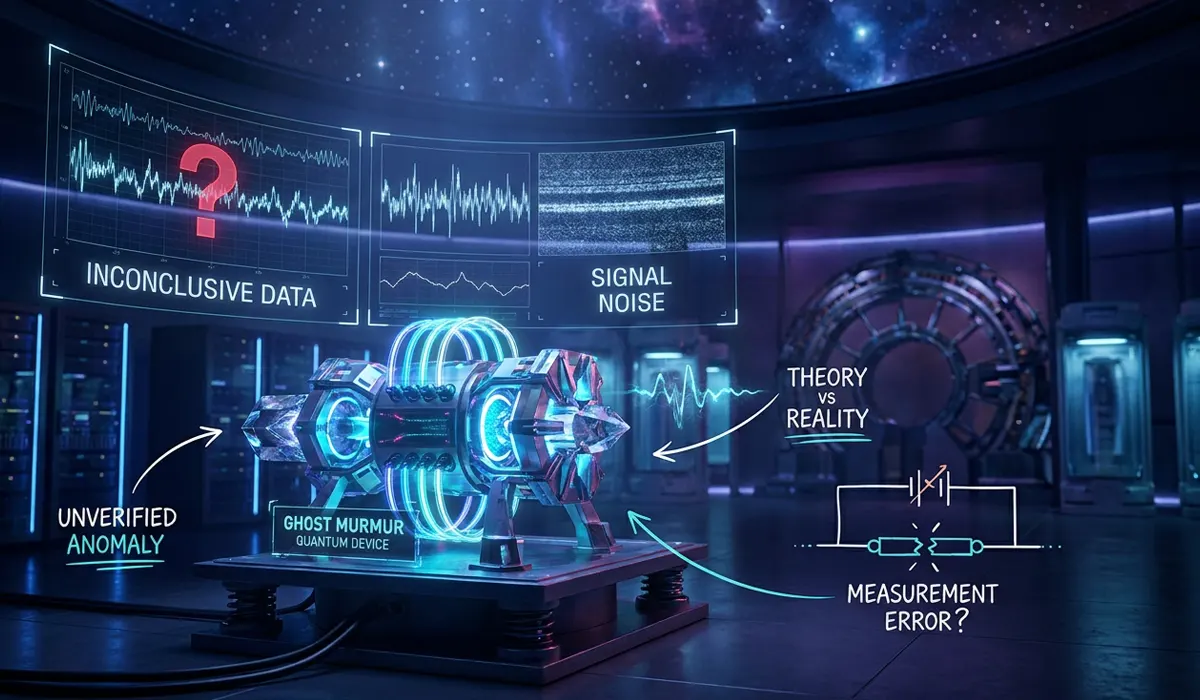
A secret machine that can hear a heartbeat from miles away sounds like something built for a spy thriller, not a lab notebook. That is exactly why the ghost murmur quantum device story grabbed attention, and exactly why physicists started asking hard questions within minutes.
The claim is simple enough to repeat and hard enough to believe: long-range quantum magnetometry, plus artificial intelligence, plus a battlefield rescue in Iran. But once you ask what the heart actually produces, how magnetic fields fall off with distance, and what noise dominates outdoors, the story gets much thinner.
The public version of the ghost murmur quantum device sounds polished, but the physics problem sits right under the surface. A human heart does create a magnetic field, yet that field is extremely faint, and faint signals do not become easier to detect just because the language around them sounds advanced.
What the Ghost Murmur story actually claims

The reported story says a CIA-linked device tracked a downed airman in southern Iran by sensing his heartbeat at a great distance, then using software to separate the pulse from environmental noise. That sounds neat, but the details matter more than the headline ever will.
If you strip away the dramatic framing, the claim depends on three separate things working together: a sensor sensitive enough to see tiny magnetic fields, an environment quiet enough for those fields to survive, and an algorithm able to identify a human pulse among countless competing signals. Each part carries its own burden.
The basic appeal of the story comes from a familiar idea: if a body emits a measurable signal, then a better detector should eventually find it. That logic is reasonable in principle, but physics does not reward wishful scaling. Signal strength, distance, and noise all obey stubborn rules.
Why the heart is a difficult target
A beating heart does generate electromagnetic activity, which is why magnetocardiography exists. In a controlled setting, researchers can record that signal with highly sensitive instruments placed very close to the body. The important phrase there is “very close.” Distance is not a minor detail; it is the whole problem.
John Wikswo’s comparison is the right starting point. If the magnetic field is barely detectable at about 10 centimeters, then moving to 1 meter drops the amplitude by roughly a factor of 1,000. That is already brutal. Push the distance out much farther, and the target signal rapidly sinks below the clutter.
That is why quantum device physics matters here more than the word “quantum.” Quantum sensors can be extraordinarily sensitive, but sensitivity is not magic. The instrument still has to discriminate a tiny source field from Earth’s magnetic field, metal objects, aircraft, terrain effects, power lines, electronics, and the body’s own motion.
Why scientists doubt the quantum device claims
The first reason scientists doubt the ghost murmur quantum device story is simple scaling. Magnetic fields from a small source weaken quickly with distance, so a heartbeat that is barely visible nearby does not remain cleanly visible across open terrain. The farther you go, the harder the signal becomes to distinguish from noise.
The second reason is environmental clutter. Real-world magnetic sensing is often limited less by the sensor itself than by what surrounds it. Mountains, vehicles, batteries, comms gear, metal debris, and even the detector’s own platform can distort measurements. A rescue scene is not a laboratory bench, and that difference matters a great deal.
The third reason is that AI can only work with data that already contains a recoverable pattern. Machine learning can improve classification, filter artifacts, and identify weak correlations, but it cannot reconstruct a heartbeat that never rose above the noise floor in the first place. Good software is not a substitute for missing signal.
Expert tip:
Wwhen a sensor claim sounds extraordinary, ask first whether the source signal survives distance before asking what the algorithm can do.
What quantum magnetometers can do, and what they cannot
Quantum magnetometers are real tools, and they are useful in serious science and medicine. They can detect tiny magnetic variations, and in the right setting they have helped study heart rhythms, brain activity, and subtle geophysical signals. That is a real achievement, not a marketing trick.
But performance in one setting does not translate automatically to another. A detector that works in a shielded room or on a patient’s chest does not become an all-terrain remote heartbeat finder simply because someone attaches “quantum” to the description. The physics stays the same, and the constraints stay in place.
That is the point many public reports blur. They treat the sensor class as if its laboratory sensitivity implies field-deployable long-range detection. In practice, the conditions become the story: shielding, distance, orientation, background field stability, and motion all decide whether the measurement is useful.
The role of magnetocardiography
Magnetocardiography measures the heart’s magnetic signature, usually for research or clinical analysis. It is a specialized method, and it works best when the subject is close to the sensor and the environment is controlled. That setup is very different from scanning a mountain range for a hidden person.
The heart’s magnetic field is also not a simple flashing beacon. It changes shape with the cardiac cycle, and its amplitude is tiny compared with everyday magnetic interference. That means the detector must not only sense a weak signal but also track its timing and separate it from moving, irregular background noise.
This is why the ghost murmur quantum device story does not pass the common-sense physics test. A claim can sound technologically modern and still violate basic measurement limits. The name does not matter. The signal chain does.
Why the rescue itself does not prove the device
A successful rescue does not prove every claimed method used in the operation. Real missions often involve multiple tools at once: visual search, infrared systems, radios, location beacons, intelligence reports, terrain analysis, and human judgment under pressure. One working element can get inflated into a myth after the fact.
That is especially true when secrecy surrounds the mission. People fill gaps with the most dramatic explanation available, and journalists sometimes repeat the flashiest version before the technical details are verified. In a case like this, the public narrative can drift far from the actual engineering.
The airman reportedly carried a survival beacon, and that matters. A beacon is a direct, purpose-built way to help rescuers. It is a far more plausible explanation than a far-field heartbeat detector, because beacon systems are designed for distance and have a clear signal path.
Why the physics keeps pushing back
If you want to test whether a remote sensing claim makes sense, start with the inverse problem: how does the signal weaken with distance, and what background does it have to fight through? That is where the ghost murmur quantum device claim runs into trouble almost immediately.
A heartbeat is not a large radiating source. It does not throw out a strong, clean magnetic beacon that can be separated from the environment at will. Instead, it produces a faint, local field that falls away fast and becomes increasingly difficult to distinguish from everything else in the world.
That is before asking whether a moving aircraft, a rugged mountain slope, or a desert rescue zone would create a stable measurement environment. The answer is no. Those settings are full of changing magnetic conditions, mechanical vibration, and signal contamination. Physics does not become more forgiving because the mission is dramatic.
What would need to be true for the claim to work
For the public story to hold, several unlikely things would have to line up at once. The heartbeat signal would need to remain detectable at great distance, the sensor would need extraordinary sensitivity in a noisy field setting, and the software would need enough genuine signal to isolate the pulse reliably. That is a tall order.
None of that is impossible in principle if you keep shrinking the gap, controlling the environment, and adding cooperative sources. But the alleged scenario is the opposite: a person hidden in rough terrain, at long range, during a rescue mission. Each added complication makes the claim less plausible, not more.
So when scientists express skepticism about the why scientists doubt quantum device narrative, they are not rejecting quantum sensing itself. They are rejecting a leap from real technology to a far more ambitious public story. That distinction matters, because the first is established, and the second remains unsupported.
What a more realistic explanation looks like
The more realistic explanation is usually less glamorous and far more ordinary. A rescue team may have used a survival beacon, radio intelligence, line-of-sight search methods, thermal tools, or other forms of situational awareness. Those are proven methods, and they fit the physics far better than a heartbeat-hunting device.
That does not make the operation any less impressive. It simply means the impressive part is the coordination, the risk, and the speed of response, not a speculative sensor claim. Good reporting should separate what was likely used from what was merely rumored after the fact.
This is where scientific discipline matters. People often hear a technical phrase like “long-range quantum magnetometry” and assume it carries more proof than it does. In reality, the phrase can hide a large gap between what a device can detect under controlled conditions and what it can do in the field.
The problem with techno-myths
Techno-myths spread because they sound like the future arriving early. They also satisfy a neat narrative urge: hidden problem, secret device, elite agency, perfect rescue. But science rarely works that way. Real progress is usually narrower, slower, and more constrained than rumor suggests.
The danger is not just that the claim may be false. The danger is that it distorts how people think science works. When every hard problem is answered by a secret device, the public loses sight of measurement limits, experimental controls, and the difference between lab performance and operational use.
That is why the ghost murmur quantum device story deserves skepticism. Not cynicism, skepticism. Those are not the same thing. Skepticism asks what evidence exists, what the geometry allows, and whether the claimed mechanism survives contact with actual physics.
What to remember when you hear the next bold sensor claim
The best way to judge a sensor story is to ask what happens to the source signal before the software ever sees it. If the signal is too weak, too distant, or too contaminated, the algorithm has nothing solid to recover. Physics sets the first boundary.
That is the central reason scientists doubt the ghost murmur quantum device story. Not because advanced sensors are fake, and not because AI is useless, but because distance, noise, and weak biological fields impose limits that a catchy label cannot erase. If the claim is real, it needs data, not atmosphere.