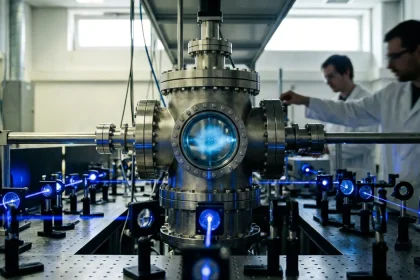


Dusty plasmas are not just lab curiosities; they are messy, many-particle systems where charge, flow, screening, and wake effects all mix at once. That is why dusty plasmas hidden patterns matter: they reveal structure that simple textbook formulas can miss when the plasma is far from ideal.
What makes this result interesting is not just that a machine-learning model fit the data well. The deeper point is that the model recovered force laws from real motion, then exposed where common assumptions about charge and screening start to fail. That is the kind of evidence physicists pay attention to.
For years, dusty plasma studies leaned on approximations that work reasonably well near equilibrium, where particles barely move and the geometry stays simple. This new work changes the question. Instead of asking only whether the system behaves as expected, researchers asked what the particles themselves can tell us about the hidden forces shaping their motion.
Why dusty plasmas hide more than they reveal
Dusty plasmas sound abstract until you picture a chamber filled with ionized gas, tiny charged grains, and a fast stream of ions flowing around them. In that environment, every grain feels electric forces, drag, screening, and wake effects at the same time, so the motion becomes a compact record of the underlying physics.
The real challenge is that the forces are not simple Newtonian pair attractions or repulsions. They can be nonreciprocal, meaning particle A does not necessarily push on particle B with the same force B pushes back with. That breaks one of the habits that makes many-body physics easier to model.
This is why dusty plasmas hidden patterns are so useful to study with data-driven methods. If you can track each particle in three dimensions with enough precision, then the trajectories become a kind of coded message. The code is noisy, but it still carries information about charge, mass, screening, and the ion wake beneath each grain.
The PNAS study behind this work used 3D particle tracking and a physics-informed neural network to recover those forces directly from experimental motion. That matters because the model did not merely predict the next position. It learned the reduced force terms in the equation of motion and used them to infer particle properties.
What the experiment actually measured
The setup was a dusty plasma inside a vacuum chamber with argon gas, an RF-driven electrode, and micron-sized melamine-formaldehyde particles levitated in a plasma sheath. A scanning laser sheet and high-speed camera tracked their 3D motion, which gave the researchers dense trajectory data over many seconds.
That detail matters because force inference from noisy motion is hard. You usually need smooth acceleration data, but real experimental trajectories contain measurement noise and brief close encounters that distort the derivatives. The team worked around that by using a weak-form loss, which compares filtered dynamics over small time windows instead of raw second derivatives.
In practical terms, that choice makes the model much less brittle. It does not pretend the data are clean; it respects the fact that they are not. That is one reason the fit reached test values above 0.99 across several experiments, even though the particles were not identical and the system was highly dynamic.
The model also built in the right physics from the start. It treated particle interactions as pairwise to leading order, allowed the forces to depend on particle position in the plasma sheath, and separately learned damping from the neutral gas. That structure was not decoration; it was what made the inference scientifically meaningful.
How machine learning extracted dusty plasmas hidden patterns
The key idea was simple but powerful. Instead of asking the model to guess everything at once, the researchers split the problem into three force components: pair interactions, environmental forcing, and velocity-dependent drag. Each part had its own neural network, and each network saw only the inputs relevant to that physical term.
That architecture matters because it prevents the model from hiding everything inside one opaque function. A single black box could fit the motion, but it would be much harder to interpret. Here, the structure forced the model to learn separable pieces of the physics, which is what makes the result credible.
One of the most interesting outcomes came from nonreciprocity. When particles sat at different heights in the plasma sheath, the interaction force was not symmetric. That fits the expectation that ion wakes beneath each grain distort the local electric environment and create an effective attractive component in some geometries.
But the model also showed where ordinary screened-Coulomb fits start to break down. In the same horizontal plane, the interaction looked closer to a reciprocal screened repulsion, yet systematic deviations remained. Those deviations are not a nuisance to ignore; they are often where the physics is telling you the approximation has limits.
Expert tip:
In complex many-body experiments, the most valuable result is often not the best fit, but the pattern of the fit errors.
Why the inferred charge and screening length matter
This is where the paper becomes more than a machine-learning story. The researchers did not stop at prediction accuracy. They used the learned interaction law to estimate particle charge, mass, and screening length, then compared those values against independent checks and standard dusty-plasma theory.
The mass estimate was the cleaner test. They inferred mass in two different ways, one from the interaction term and another from the damping coefficient, then found that the two matched well. That agreement is important because it shows the model was not just memorizing trajectories; it was capturing physically consistent force balance.
The charge and screening length were more revealing. Standard orbital-motion-limited theory suggests a fairly simple relation between charge and particle size, but the experiment found a charge-size scaling that deviated from the simplest expectation. The fitted power law ranged roughly from 0.30 to 0.80, depending on pressure.
That pressure dependence is a real clue. It suggests that ion-neutral collisions, sheath structure, and wake effects may all matter more than the cleanest textbook picture assumes. The precise mechanism is still not fully settled, and the paper is careful about that. That honesty makes the result stronger, not weaker.
The screening length also behaved in a way that standard assumptions would not predict. It varied with particle size and appeared to change across the sheath, even though one might expect it to depend mainly on plasma conditions. In other words, the particles were not just objects inside the plasma; they were also probes of the plasma itself.
What the model reveals about physics, not just prediction
A lot of machine-learning papers stop at saying the model worked. That is the easy part. The harder part is asking whether the learned function corresponds to any real physical quantity, and whether it survives checks from other measurements. This study did that, which is why it stands out.
The most useful lesson from dusty plasmas hidden patterns is that a system can be partially understood even when its forces are not fully known in advance. The particles move under conditions where simple equilibrium theory fails, but the motion still contains enough information to reconstruct meaningful force laws.
That is a major point for many-body physics. Real systems rarely sit still long enough to satisfy ideal assumptions. They drift, flow, interact nonlinearly, and often exchange energy with their environment. If you want to learn from them, you need models that match that complexity without losing physical discipline.
The authors also tested their method on simulated systems with known nonreciprocal interactions. That matters because it checks whether the inference pipeline itself creates fake results. Their simulations showed the approach could still recover mass and charge well, while revealing how ion wakes can reduce the apparent screening length. That supports the experimental conclusions.
Why this is useful beyond dusty plasmas
The physics here is specific, but the method travels well. Any many-body system where you can track motion with enough precision could benefit from the same style of analysis, especially when interactions are nonlinear, nonreciprocal, or only partly known.
That includes colloids, active matter, some biological collectives, and possibly other driven plasma systems. The common thread is not the material itself. It is the inference problem: how do you extract lawful behavior from motion when you do not already know the full force law?
This is where the study feels genuinely useful. It does not promise magic, and it does not claim machine learning replaced theory. Instead, it shows how a physics-constrained model can sharpen theory by telling you which assumptions hold, which ones drift, and which ones deserve a new look.
For dusty plasmas, that means the particles may be acting as more than just test objects. They become moving sensors for charge structure, sheath gradients, and wake-mediated interactions that are hard to access any other way. That is a practical advance, not just a computational one.
The part readers should not miss
The headline is not simply that AI analyzed plasma data. The real result is that a physics-guided model extracted force laws from real experimental trajectories and found deviations from common dusty-plasma assumptions about charge and screening. That is a sharper and more defensible claim.
The word “hidden” is doing a lot of work here. These patterns were not hidden because the physics was mystical or unknowable. They were hidden because traditional approximations average away the very details that matter once the system leaves equilibrium. Better data and better modeling exposed them.
That is how progress usually looks in experimental physics. First, a system looks messy. Then a well-built model separates signal from noise. After that, the interesting part begins: not proving the theory right, but finding the places where it stops being enough. That is the real value of dusty plasmas hidden patterns.
FAQ
What are dusty plasmas?
Dusty plasmas are ionized gases that contain tiny charged particles, usually micrometer-sized grains, along with electrons and ions. They appear in space, planetary rings, laboratories, and some industrial processes.
Why do dusty plasmas show nonreciprocal forces?
Ions stream past the charged grains and form wake structures below them. Those wakes alter the force one particle feels from another, so the push is not always equal and opposite in the usual simple sense.
What did the AI model learn from the experiment?
It learned the effective interaction force between particle pairs, the environmental force that confined the particles, and the drag term from the background gas. It also helped estimate mass, charge, and screening length.
Why is the charge-size relation important?
Simple dusty-plasma theory often predicts a clean scaling between particle size and charge. The experiment found departures from that idealized expectation, which suggests more physics is involved, especially in the plasma sheath.
Can this method work in other systems?
Yes, in principle. Any many-body system with high-quality trajectory data and partly known symmetries could be a candidate, especially if the interactions are hard to write down from first principles alone.
The deeper lesson from the data
This paper is not saying that theory failed. It is saying that theory, data, and model structure work best when each one is honest about its limits. The model succeeded because it respected the symmetries of the experiment while still leaving room for unexpected force behavior.
That is the kind of result that should stay with readers. Not because it sounds dramatic, but because it shows a disciplined way to extract real physics from complicated motion. In a field where many approximations are convenient but incomplete, that matters.
For anyone tracking dusty plasmas hidden patterns, the real takeaway is simple: the particles were never random. The challenge was building a tool sharp enough to read them correctly. This study shows that when you pair precise experiments with physically constrained learning, the plasma starts giving up its structure.
Source: PNAS article on physics-constrained machine learning for force inference in laboratory dusty plasmas, edited by Curtis Callan Jr., Princeton University; received March 24, 2025; accepted July 1, 2025.