

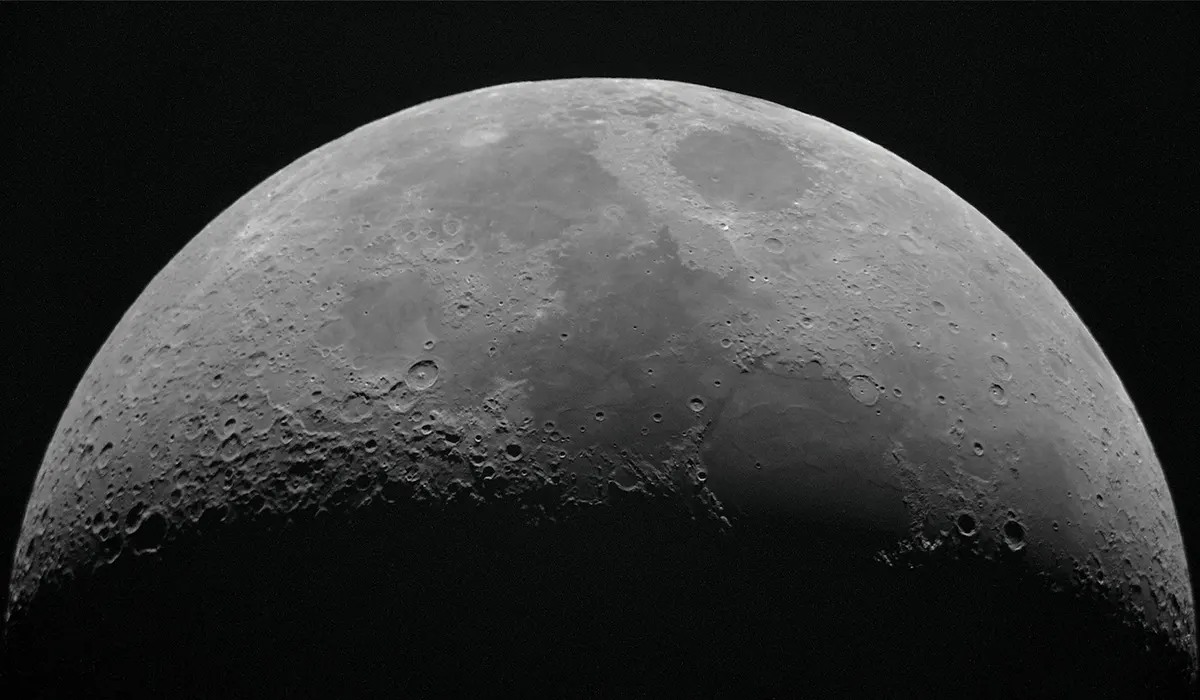
The Moon still gets hit, and when it does, it keeps the evidence in plain sight. If you have ever wondered what hit the moon and left a bright new scar, the answer is not exotic at all: a small impactor, moving fast enough to turn rock into spray.
- The Moon Is Not a Frozen Surface
- Clue 1: The Brightness Means Fresh Material
- Clue 2: The Ray Pattern Reveals the Impact
- Clue 3: Orbital Timing Narrows the Event
- Why Bright Craters Fade So Quickly by Lunar Standards
- Why This Matters Beyond a Single Crater
- What Likely Hit the Moon
- Why the Moon Keeps Teaching Us the Same Lesson
- Frequently Asked Questions
What matters is not the size of the object alone, but the violence of the collision. A body only a few meters across can excavate a crater tens of meters wide, because lunar gravity is weak and impact speeds are enormous. On the Moon, speed does most of the work.
That is why a fresh crater can look almost surgical from orbit. It is a scar of physics, not mystery. The brightness comes from newly exposed material, and the pattern around it tells scientists a lot about the impact, the surface, and the Moon’s slow but steady evolution.
The Moon Is Not a Frozen Surface
The Moon looks permanent from the backyard, and that is part of its appeal. But permanence is misleading. Its surface records a long history of bombardment, from the ancient era that carved the giant basins to the smaller impacts that still happen today.
For most people, the familiar face of the Moon seems unchanged night after night. Yet lunar orbiter data show a surface that continues to take damage, heal visually, and age under space weathering. The Moon keeps a written record of its collisions, even if we do not watch each one happen.
The dark maria, which help form the “Man in the Moon,” are not seas at all. They are volcanic plains filling enormous impact basins from a much earlier chapter in Solar System history. The newer bright craters sit on top of that older story, adding fresh marks to an already battered surface.
That contrast matters because a bright crater is not just a hole. It is a timestamp. When researchers ask what hit the moon and left a bright new scar, they are really asking when it happened, how much energy it released, and how quickly the Moon erases the evidence.
Clue 1: The Brightness Means Fresh Material
A young crater stands out because it has not had time to age. The impact blasts apart the top layer of regolith and throws cleaner material outward. That exposed material reflects more sunlight, so the crater and its rays appear much brighter than the surrounding terrain.
This brightness is one of the first clues scientists use. On the Moon, light and dark are not just aesthetic features; they are a record of surface processing. Fresh ejecta can look strikingly white at first, then slowly dim as solar wind and micrometeorite hits roughen and darken the grains.
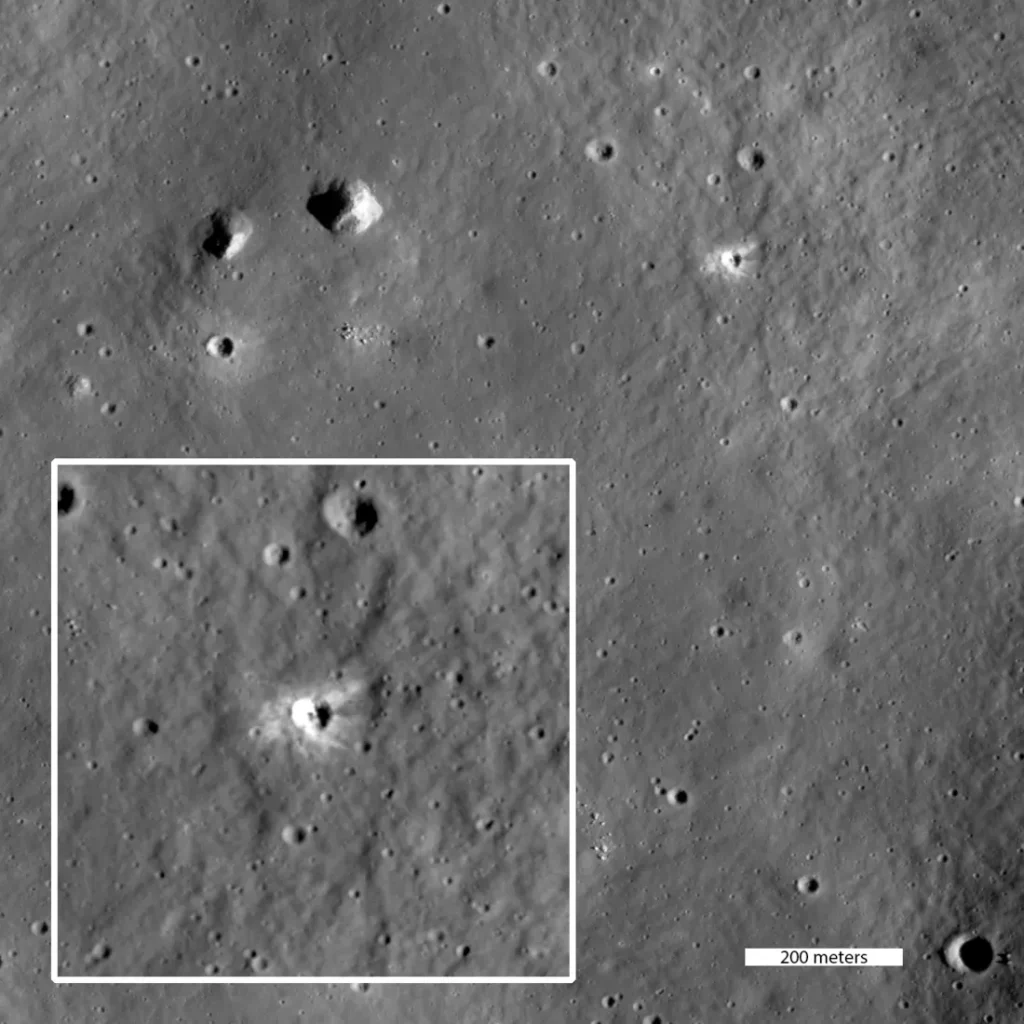
The newly identified crater described by Lunar Reconnaissance Orbiter observations is roughly 22 meters wide, about the size of a large house. What makes it noticeable is not scale, but contrast. A small crater can still create a big visual signature if it excavates bright material from beneath a darker surface layer.
That contrast also helps answer what hit the moon and left a bright new scar. The object was likely a meteoroid or small asteroid fragment, not something unusual. In lunar terms, ordinary is often dramatic enough. Even modest impactors arrive at tens of kilometers per second, which is plenty to reshape rock.
Clue 2: The Ray Pattern Reveals the Impact
A second clue lies in the ejecta rays. When a projectile strikes the surface, it does not simply punch a neat hole. It also launches material in all directions, and that spray can settle into streaks radiating from the crater like spokes.
Those rays are important because they tell scientists about the direction and energy of the impact. They also help distinguish a young crater from an old one. If the rays are crisp and bright, the crater is usually recent. If they have faded into the background, time has done its work.
The geometry of the surrounding ejecta can also help rule out other explanations, such as a preexisting feature that only looks new under different lighting. Orbital imaging from different dates is essential here, because the Moon’s low-angle sunlight can create deceptive shadows that mimic fresh terrain.
Note
A bright lunar crater is often young because space weathering slowly erases the contrast, not because the impact itself was unusually large.
This is where repeated imaging becomes so valuable. The Lunar Reconnaissance Orbiter Camera team compared images taken before December 2009 and after December 2012, narrowing the impact window by looking for what changed and what stayed fixed. That kind of before-and-after work is how what hit the moon and left a bright new scar gets answered with evidence instead of guesswork.
Clue 3: Orbital Timing Narrows the Event
The third clue is temporal rather than visual. Scientists do not need to watch an impact happen if they can bracket the event between two observations. That is exactly what happened here: the crater was absent in earlier imagery and present in later data.
This method sounds simple, but it is a careful piece of detective work. Orbital cameras revisit the same regions under varying illumination and resolution, and researchers compare them by registration, contrast, and shadow structure. A new crater appears as a change that should not be there.
That approach does more than identify one feature. It helps build an impact rate for the Moon. If a fresh crater appears in a known time window, scientists can estimate how often small impactors strike the lunar surface, which matters for future missions and for understanding hazard levels beyond Earth.
The answer to what hit the moon and left a bright new scar is therefore not just “something small and fast.” It is also “something that can be dated, measured, and compared with other impacts.” That is what turns a striking image into useful science.
Why Bright Craters Fade So Quickly by Lunar Standards
Lunar bright spots do not stay bright forever. That does not mean they vanish overnight, but the contrast weakens as the surface takes repeated microscopic abuse. Solar wind particles implant atoms, micrometeorites garden the soil, and radiation slowly alters the grains.
Scientists call this space weathering, and it is one reason the Moon’s face is not a perfect archive. The record survives, but not in pristine condition. A young crater may look almost white at first, then gradually blend into the surrounding terrain over thousands to millions of years.
Tycho is a good comparison because it is still relatively young, at about 108 million years old. Its bright rays are visible from Earth because the crater is young enough, geologically speaking, that weathering has not yet erased the contrast. Older craters lose that clarity first.
So when people ask what hit the moon and left a bright new scar, the physical answer is only half the story. The other half is how quickly the Moon dulls the evidence after the hit. The fresh scar is temporary, which makes it more valuable to observe while it lasts.
Why This Matters Beyond a Single Crater
A single fresh crater may seem minor next to the Moon’s giant basins and old lava plains, but it gives scientists a useful calibration point. Every new impact helps refine the crater production rate, which feeds into models of surface age and exposure history.
That matters for more than academic bookkeeping. Spacecraft orbiting the Moon need impact statistics to assess risk from small debris. Human missions will also need realistic expectations about how often new impacts occur, especially for exposed equipment, landers, and future surface infrastructure.
The crater also helps researchers test models of ejecta brightness and darkening. If scientists know when a crater formed and can measure its current appearance, they can estimate how fast the contrast fades. That improves age dating across the lunar surface, where fresh rays often serve as a clue to relative youth.
In that sense, what hit the moon and left a bright new scar is not a curiosity sitting in orbit. It is a data point that links impact physics, surface change, and mission planning. Small events can still teach large lessons when the environment preserves them well.
What Likely Hit the Moon
The most likely answer is a natural impactor: a meteoroid or small asteroid fragment arriving at very high speed. The Moon has no atmosphere thick enough to blunt most incoming objects, so even modest bodies strike the surface with brutal efficiency.
At lunar velocities, impact energy rises quickly with speed. A rock only a few meters across can excavate a crater far larger than itself because the kinetic energy scales with mass and the square of velocity. That is why the resulting scar can look disproportionately large compared with the object that caused it.
There is no need to invoke anything unusual here. The Moon receives a steady rain of small bodies, and most leave only tiny marks or no visible traces at all. Occasionally, the conditions line up so that the impact is bright enough and recent enough to stand out in orbit.
So if you are searching for what hit the moon and left a bright new scar, the best answer is usually the least dramatic one: a natural rock, moving fast, arriving without warning, and leaving a crater that only orbital imaging could catch in time.
Why the Moon Keeps Teaching Us the Same Lesson
The Moon is easy to underestimate because it looks calm. Yet calm is not the same as unchanged. Every fresh crater is a reminder that the Solar System still contains moving debris, active collisions, and surfaces that quietly record those events.
That is why lunar monitoring remains important. The Moon gives us a nearby laboratory for impact physics, regolith behavior, and space weathering. It also gives a practical warning: even a seemingly inert world can be altered by a small object arriving at cosmic speed.
The best part is that we do not need to guess. We can compare images, measure rays, and track fading brightness over time. That is how scientists build confidence in a claim, and that is why the question what hit the moon and left a bright new scar has a satisfying answer grounded in observation.
Frequently Asked Questions
What hit the Moon and left a bright new scar?
Most likely a small meteoroid or asteroid fragment struck the lunar surface at high speed, excavating fresh material that appears bright before space weathering darkens it.
Why are some lunar craters bright while others are dark?
Bright craters are usually younger. Their ejecta has not yet been darkened by solar wind, micrometeorites, and radiation.
How do scientists know a crater is new if nobody saw the impact?
They compare orbital images taken at different times. If the crater was absent in earlier photos and present later, they can narrow down when it formed.
Do fresh lunar craters stay bright forever?
No. Their rays and ejecta fade as the surface is weathered by constant exposure to space.
Can new impacts on the Moon help future missions?
Yes. They improve estimates of impact rates, which helps with mission planning, surface safety, and understanding how lunar terrain changes over time.
The real lesson is that the Moon is not dead, only patient. A bright new crater may fade, but while it lasts it gives us a direct answer to what hit the moon and left a bright new scar, and that answer is written in physics, not folklore.
Source: NASA Lunar Reconnaissance Orbiter Camera observations and standard lunar impact and space weathering research literature.