
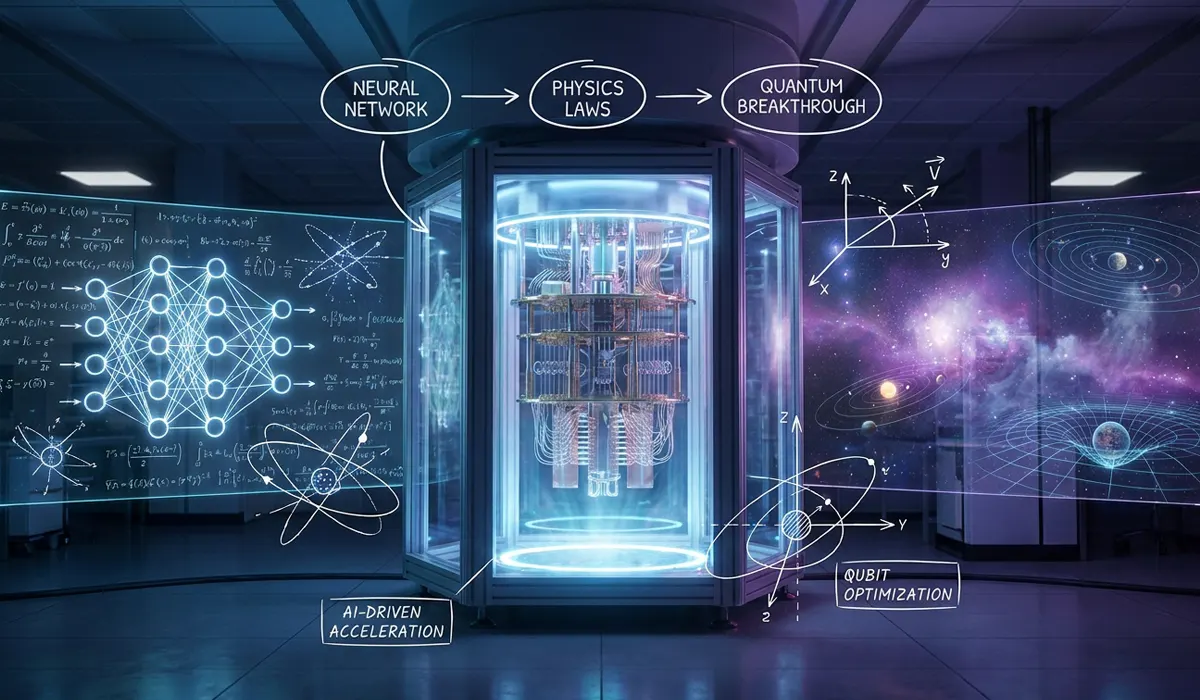
A neural network can burn through a month of supercomputer time before it becomes useful. In a Chalmers study, that wait fell to roughly three days because the AI learned physics laws before training began.
That phrase needs care. The system did not wake up and discover Maxwell’s equations like a student with coffee-stained notes. Researchers built physical knowledge into the model, so it stopped wasting time rediscovering rules that physicists already know.
The result matters because optical design often moves at the pace of simulation, not imagination. If you want thinner lenses, better photonic crystals, or optical links for quantum computers, speed changes what engineers can realistically test.
Why “AI Learned Physics Laws” Is More Than a Catchy Line
The phrase “AI learned physics laws” sounds dramatic, but the cleaner version tells a better story. Researchers at Chalmers University of Technology in Sweden gave a neural network direct knowledge of electromagnetic behavior, then asked it to predict how nanostructures scatter light.
That distinction matters. Ordinary neural networks learn patterns from examples. If researchers feed them enough simulated structures and optical responses, they can infer useful relationships. Yet they also spend part of their training budget learning facts that physics already nailed down more than a century ago.
For light, those facts come mainly from electromagnetism. Maxwell’s equations describe how electric and magnetic fields evolve, interact with matter, and travel through space. They do not solve every engineering design for you, but they define the boundaries inside which every real answer must live.
Chalmers physicist Philippe Tassin and colleagues work in nanophotonics, where small geometric changes can shift optical behavior sharply. At scales smaller than the wavelength of light, intuition often fails. A shape that looks simple on a screen can produce a response that surprises even trained researchers.
That is where machine learning earns its keep. The network can scan relationships among geometry, material parameters, and optical scattering faster than a human can reason through them by sight. But without physics built in, the model needs huge training sets before it behaves reliably.
The Real Bottleneck Was Never the Neural Network
The slow part in this kind of work does not always come from training the network itself. It often starts earlier, when researchers create the examples. Each data point can require a full electromagnetic simulation, and one simulation may take ten minutes to an hour.
Now multiply that by tens of thousands. Viktor Lilja, a doctoral student at Chalmers and lead author of the study, described training sets with as many as 40,000 simulations. That can turn one idea into a month of waiting before the network even starts helping.
Anyone who has worked with simulations knows the quiet irritation here. You launch a job, check the queue, get coffee, come back, and the machine still has not touched your run. The science feels elegant; the calendar feels less forgiving.
The Chalmers group reports that their physics-aware approach cut that preparation time to about one tenth. A workflow that once took around 30 days could take roughly three. That change does not make hard optics easy, but it changes the rhythm of research.
That matters.
When design cycles shrink, scientists can ask better questions. They can test more geometries, reject bad assumptions earlier, and spend less time waiting for brute-force data. In nanophotonics, that speed can decide whether a concept stays theoretical or reaches fabrication.
How the Chalmers Team Built Physics Into the Model
The paper, published in Laser & Photonics Reviews, presents a framework for adding physical knowledge to machine learning models for electromagnetic scattering. The key technical idea uses quasinormal modes, which describe the natural resonant responses of open optical systems.
A closed musical instrument has resonances you can hear as tones. Optical nanostructures have resonances too, though they involve electromagnetic fields rather than sound. Because light can radiate away, these resonances lose energy, so physicists describe them with quasinormal modes.
Those modes help organize scattering problems. Instead of forcing a neural network to learn every response from raw examples, researchers can guide it with mathematical structures that already encode known physics. The network still learns, but it learns inside a smarter frame.
Here is the counter-argument: you might ask why researchers need machine learning at all if they already know the equations. That is fair. Maxwell’s equations govern the system, but solving them for complex nanostructures across huge design spaces can still cost enormous time.
The equations tell you what must happen. They do not instantly tell you which nanoscale pattern gives the optical response you want. That search problem, especially across many geometries and frequencies, can become painfully large even when the underlying physics looks settled.
What the Network Actually Predicts
After training, the Chalmers network could examine a new structure and estimate its optical properties in a millisecond, according to the researchers. That does not replace full validation, but it gives scientists a fast filter before committing to heavier simulations.
In practical terms, the model can help researchers ask: if I change this nanostructure, how will it reflect, transmit, or scatter light? That question sits at the heart of optical component design, from engineered materials to photonic devices for future quantum hardware.
The team also reports better estimates and fewer obvious errors. That part deserves attention because speed alone can mislead. A fast wrong answer wastes time in a different way. Physics integration aims to make the model faster and more faithful to known constraints.
Expert Tip: The Shortcut Is Not Magic
A physics-informed network saves time because it starts with rules nature already enforces, not because it guesses better by luck.
Why Nanophotonics Needs This Kind of Shortcut
Nanophotonics deals with light on scales where ordinary optical intuition starts to break. A camera lens bends light through smooth glass. A nanophotonic structure can control light using patterns smaller than the wavelength itself, often through interference and resonance.
Natural materials limit what designers can do. Glass, silicon, metals, and crystals each respond to light in specific ways. By arranging materials into artificial structures, researchers can create optical behavior that no single natural material offers in a simple block.
That opens paths toward lighter camera lenses, thinner eyeglass lenses, compact sensors, and photonic chips. It also creates a headache. Once structure matters as much as material, designers must search a huge space of shapes, sizes, spacings, and wavelengths.
This is where the Chalmers result becomes useful beyond one laboratory. A physics-aware model can act like a fast scientific assistant during early design. It can reject poor candidates quickly and point researchers toward structures worth testing with full electromagnetic solvers.
The central point is not that machines “understand” light like physicists do. They do not. The point is that researchers can combine human theory, numerical simulation, and statistical learning in a way that respects physical law from the start.
You can also read this: Phonons Swap Angular Momentum in Solids

AI Learned Physics Laws for Optical Components
Optical components rarely get public attention unless they appear inside phones, telescopes, or medical tools. Yet they control the practical movement of light through modern technology. Better optical design can mean smaller devices, lower losses, and cleaner signals.
Chalmers’ work touches that design problem directly. The researchers want to model artificial optical materials and components that manipulate light more precisely than ordinary materials allow. The same basic physics connects a thin lens and a nanostructured photonic crystal.
The difference lies in scale and tolerance. At the nanoscale, a few nanometers can change a device’s response. Manufacturing errors, material losses, and frequency dependence all matter. A useful model must respect those constraints rather than simply find a pretty numerical pattern.
This is why “AI learned physics laws” works as a shorthand only if we treat it carefully. The system gained physical structure through human design. Researchers supplied the law-like scaffolding, then let the network learn the remaining relationships more efficiently.
A helpful way to think about the advance is this:
- The researchers kept Maxwell’s equations close to the model.
- They used quasinormal modes to represent optical resonances.
- They reduced the number of expensive simulations needed for training.
- They produced fast predictions that can guide optical design.
That list sounds modest, but scientific progress often looks exactly like this. A research group removes one expensive step, improves error behavior, and gives other researchers a clearer way to repeat the method. The practical value comes from that discipline.
The Quantum Computing Link Needs Careful Language
The post title says this may change quantum computing. That statement needs a narrow reading. The Chalmers result does not build a quantum computer, fix qubit errors, or prove a new quantum architecture. It improves a design tool for optical structures.
Still, the connection is real. Chalmers researchers work with colleagues in microtechnology and nanoscience, where Sweden’s first large-scale quantum computer effort is underway. Quantum systems often need precise control over signals, including microwave and optical links in certain architectures.
Optical frequencies matter because photons can carry information with low noise over long distances. If quantum processors eventually need to connect across chips, labs, or networks, engineers will need components that guide, reflect, and couple light with very high precision.
One area mentioned by the Chalmers team involves mechanically compliant photonic crystals. These structures can reflect light very efficiently while also responding mechanically. In quantum technology, that combination can support devices where light, motion, and quantum states interact.
Here, the physics gets subtle. A photonic crystal does not become useful just because a neural network designed it. Researchers still need fabrication, loss measurements, thermal analysis, integration tests, and quantum-level performance checks. The model speeds the search; experiments still decide.
Where Quantum Devices Could Benefit First
The most likely near-term benefit sits in component design, not full quantum processors. Better modeling can help researchers design mirrors, cavities, waveguides, and couplers. These parts may support communication between quantum systems or improve control inside photonic experiments.
A high-reflectivity optical structure, for example, can help trap light in a cavity. A cavity can strengthen light-matter interaction. Stronger interaction can matter for sensing, signal conversion, or coupling quantum states. Each step needs careful engineering rather than slogans.
If you follow quantum computing news, keep this distinction in mind. A tool that improves photonic design can support quantum technology without directly solving quantum computing. That does not weaken the result. It places it where it belongs.
Why This Method Makes Scientific Sense
Physics-informed machine learning has grown for a simple reason: data alone can waste effort. If a model must learn conservation laws, symmetries, boundary conditions, or wave equations only from examples, it spends training capacity on relationships researchers already know.
In electromagnetic scattering, the known relationships carry real weight. Fields must satisfy Maxwell’s equations. Materials respond through defined optical properties. Resonances shape spectra. Energy cannot behave arbitrarily. A model that ignores these facts invites errors outside the training set.
The Chalmers framework uses knowledge integration rather than pure data fitting. That phrase may sound dry, but it marks a useful shift. The network no longer acts as a black box trained only on examples. It receives physical structure upfront.
This also helps interpretation. Researchers often distrust neural networks because they can produce accurate-looking answers for unclear reasons. When a model includes familiar equations or modal descriptions, scientists can inspect its behavior through concepts they already use in physics.
That does not make every prediction transparent. Neural networks still contain learned parameters that resist simple explanation. But a model tied to quasinormal modes starts from a language physicists understand. It narrows the gap between numerical output and physical reasoning.
What This Does Not Prove
The study does not show that a machine has independent scientific understanding. It also does not show that every optical design problem will shrink by the same factor. Results depend on the problem, the model, the training set, and the physics encoded.
The reported tenfold speed gain refers to this research context. Other groups will need to test similar frameworks on different geometries, materials, frequency ranges, and device classes. Good science travels through repetition, not through one attractive number.
There is another limit. Neural networks can interpolate well inside familiar design spaces, but they may fail when pushed too far beyond training conditions. Physics helps, yet it does not remove the need for verification with high-fidelity simulations and experiments.
Researchers also need to consider fabrication. A nanostructure that performs beautifully in simulation may demand tolerances that a lab cannot meet consistently. Real materials have roughness, defects, temperature drift, and losses. Nature always adds footnotes to clean models.
That is why the Chalmers result feels strongest when framed as an acceleration of design, not an automatic replacement for human physics. The model helps researchers move faster through the search space while keeping the final burden of proof where it belongs.
Why the Study Deserves Attention Anyway
Even with those limits, this work points toward a better style of scientific machine learning. The most useful systems will not simply digest more data. They will combine data with equations, constraints, and domain knowledge that researchers have built over decades.
That lesson reaches beyond optics. Fluid dynamics, plasma physics, climate modeling, materials science, and astrophysics all face similar problems. Simulations cost time. Data remain incomplete. Physical laws define boundaries. Models that respect those boundaries can do more with less.
For readers outside the field, the takeaway is simple: the future of machine learning in science may look less like replacing physicists and more like giving them sharper instruments. The best tools will know enough physics to avoid wasting everyone’s time.
The Chalmers team built a faster way to design optical components because they did not ask the network to start from ignorance. They gave it the bones of the theory first. That choice changed the practical cost of asking new questions.
Source: Viktor A. Lilja, Albin J. Svärdsby, Timo Gahlmann, and Philippe Tassin, “A General Framework for Knowledge Integration in Machine Learning for Electromagnetic Scattering Using Quasinormal Modes,” Laser & Photonics Reviews, published March 17, 2026. DOI: 10.1002/lpor.202502769.
Additional source material: Chalmers University of Technology release on physics-informed neural networks for nanophotonic optical component design, with comments from Philippe Tassin and Viktor Lilja.