

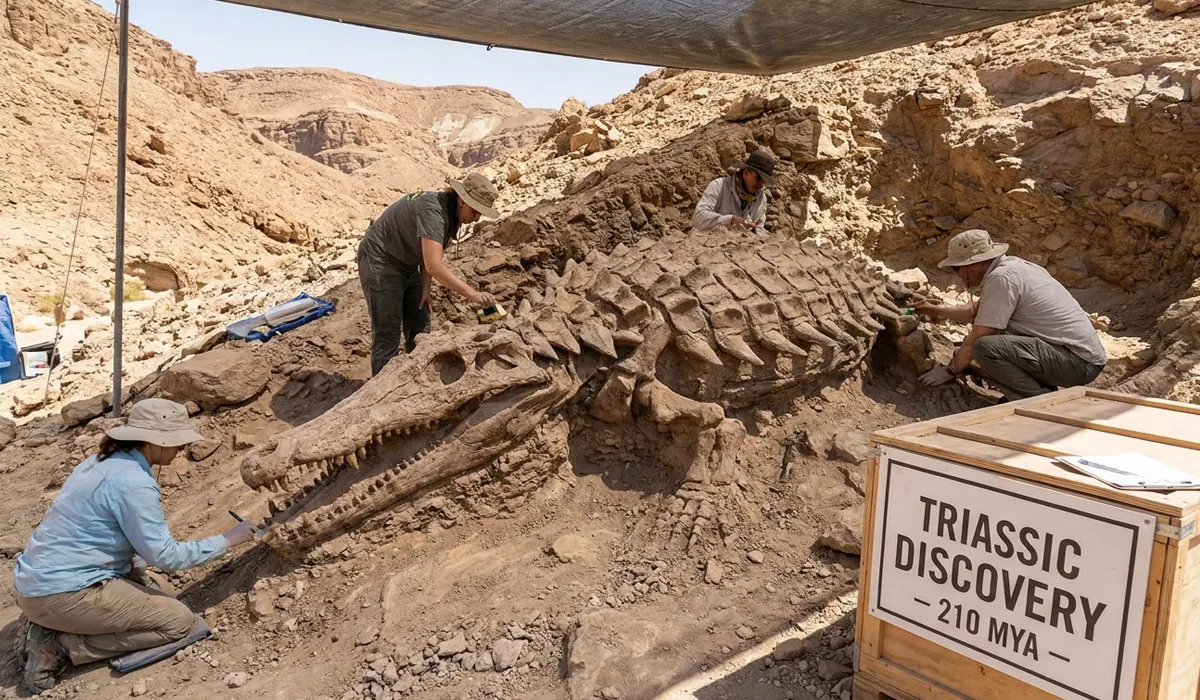
A fossil can sit in a museum drawer for decades and still keep its best secret. That is what happened with a new crocodile cousin discovered from Ghost Ranch, New Mexico, after researchers took a closer look at bones first collected in 1948.
- The New Crocodile Cousin Discovered Was Hiding in Plain Sight
- Why This 210-Million-Year-Old Skull Looks So Unusual
- The Jaw Muscles May Be the Real Story
- The New Crocodile Cousin Discovered Was Not a Dinosaur
- What the Name Eosphorosuchus Lacrimosa Means
- What Makes This Find Different From Hesperosuchus
- Ghost Ranch Was More Than a Dinosaur Graveyard
- Why Bite Mechanics Matter More Than the Name
- What This Tells Us About Early Crocodile Evolution
- A Small Skull With a Large Evolutionary Message
The animal was not huge. It did not rule the Late Triassic like a giant predator. But its skull tells a sharper story: this small crocodylomorph had a short, reinforced face built for a stronger bite than its close relatives.
That detail changes the question. Instead of asking when crocodile relatives became diverse, we now have to ask how early that diversity began, and whether small Triassic predators were already dividing up food and hunting roles more carefully than we assumed.
The New Crocodile Cousin Discovered Was Hiding in Plain Sight
The fossil now has a name: Eosphorosuchus lacrimosa. Researchers Miranda Margulis-Ohnuma, Alexander A. Ruebenstahl, Dalton L. Meyer, and Bhart-Anjan S. Bhullar described it in Proceedings of the Royal Society B on April 15, 2026, after studying a long-overlooked Yale Peabody Museum specimen.
The American Museum of Natural History team collected the specimen at Ghost Ranch in 1948, from the famous Coelophysis quarry in the Chinle Formation. Later, Yale received the block. For decades, researchers treated the fossil as a possible example of Hesperosuchus agilis, another early crocodylomorph.
That old label made sense at the time. Fossils from this part of the crocodylomorph family tree often come crushed, incomplete, or mixed with other bones. Anyone who has handled museum specimens knows the feeling of reading an old paper tag and wondering what the rock still hides.
But the Yale team did not just accept the old identification. They studied the skull, jaw, palate, limb bones, ankle, foot, osteoderms, and micro-CT data. The anatomy kept pointing in one direction: this was not simply another Hesperosuchus. It represented a distinct animal.
Why This 210-Million-Year-Old Skull Looks So Unusual
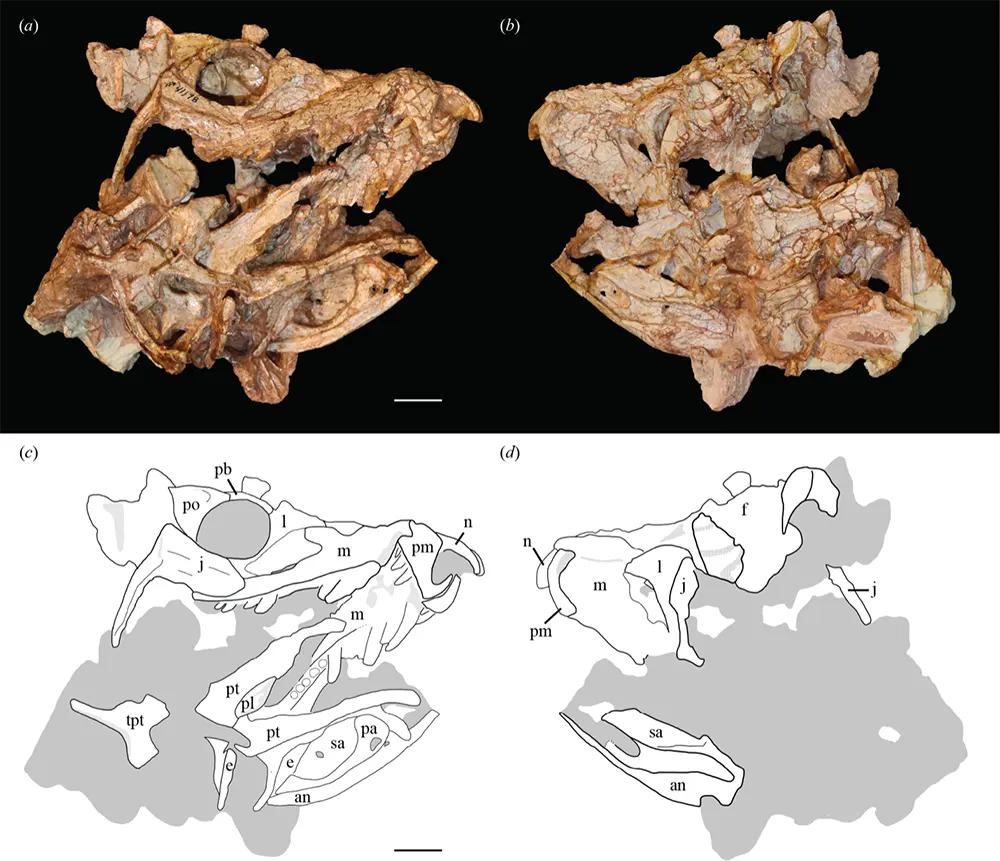
The most striking feature of Eosphorosuchus lacrimosa sits in the face. Most early crocodylomorphs of this size had longer, lighter skulls. This one had a short snout, broad facial bones, and a reinforced region around the antorbital opening in front of the eye socket.
That sounds technical, but the physical idea is simple. A shorter snout can reduce bending stress during biting, much like a shorter wrench flexes less than a long one. In living animals, short faces often connect with stronger bites, though anatomy never gives only one answer.
The researchers measured resistance to bending in the maxilla and front part of the jugal, using second moment of area from three-dimensional bone models. In the sampled early crocodylomorphs, Eosphorosuchus showed the highest size-corrected values for these skull parts.
That matters.
This does not mean the team directly measured bite force in a living animal. They could not. The animal died roughly 210 million years ago. But bone geometry gives a useful mechanical clue, and the clue here points toward a skull that could better resist biting forces.
New Crocodile Cousin Discovered With a Shorter, Stronger Face
The antorbital fenestra, the opening in front of the eye, looked unusually small and slit-like. Around it, the antorbital fossa formed a large, clear depression. In Eosphorosuchus, the lacrimal bone contributed heavily to that area, making the face look unlike close relatives.
At first, I would be cautious here. A crushed fossil can fake strange proportions. Compression can shorten, bend, and shift bones. But actually, both sides of the skull preserve the same odd facial pattern, and the researchers also compared overlapping bones against other specimens.
The maxilla carried fewer tooth sockets than the Ghost Ranch specimen previously called Hesperosuchus. The front teeth also stood out more from the rear teeth. The posterior teeth curved backward, closer to the ancestral pseudosuchian condition than to some later crocodylomorph patterns.
The Jaw Muscles May Be the Real Story
The paper’s strongest scientific point is not simply that a new species got named. Paleontology names new animals often. The more interesting point lies in function: Eosphorosuchus lacrimosa seems to preserve evidence for a different feeding strategy among small early crocodile-line predators.
Its postorbital bone, which forms part of the region behind the eye, had a broad triangular shape rather than the more delicate three-pronged form seen in many early crocodylomorphs. That matters because this region connects to the upper temporal arch, a major jaw-muscle attachment area.
The lower jaw adds another clue. The surangular bone carried a large ridge and fossa on its outer surface. The researchers interpret that feature as evidence for a strongly developed external adductor muscle, part of the jaw-closing system in reptiles.
Here is the key physical point: strong bites do not come from teeth alone. Teeth cut, puncture, or grip, but muscles deliver force and bones handle stress. Eosphorosuchus seems to combine all three: sharp teeth, stout skull elements, and expanded jaw-muscle attachment surfaces.
The New Crocodile Cousin Discovered Was Not a Dinosaur
Ghost Ranch is famous for Coelophysis, a slim early dinosaur found in large numbers there. That fame can blur the rest of the ecosystem. Eosphorosuchus lived alongside dinosaurs, but it belonged to Crocodylomorpha, the broader group that includes modern crocodilians and their extinct relatives.
Crocodylomorph does not mean “modern crocodile with a different name.” Early members of this group often looked quite different from living crocodiles. Many were small, long-legged, land-living predators. They moved through Triassic environments where dinosaurs had not yet become the only story people remember.
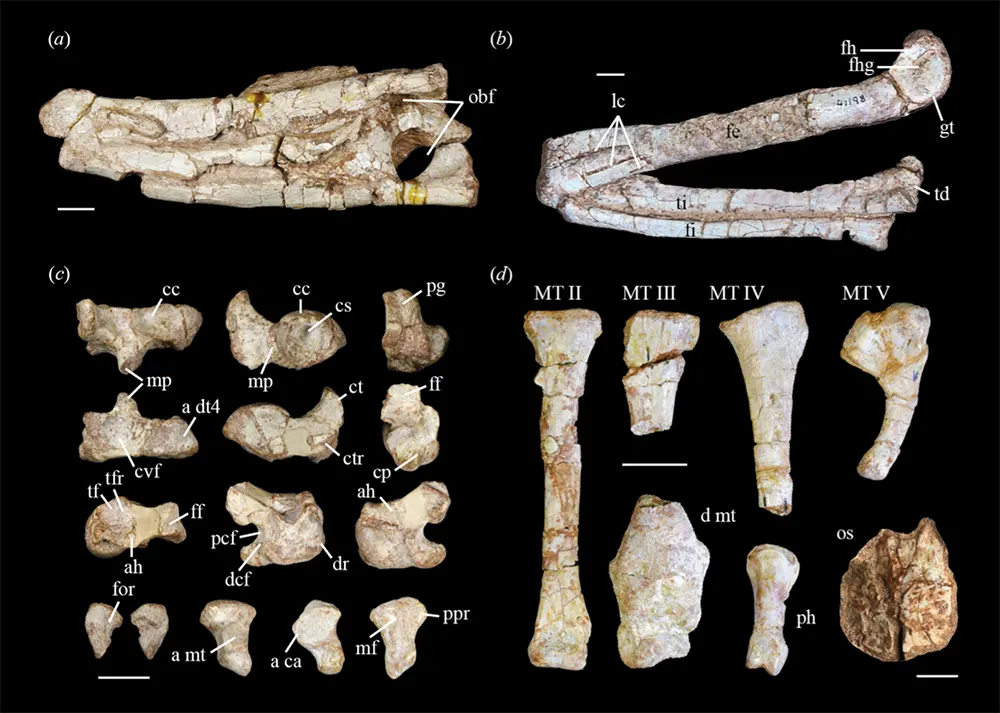
The fossil includes an anterior skull, part of the left lower jaw, a cervical vertebra, both pubes, left hindlimb bones, ankle bones, metatarsals, a phalanx, and several osteoderms. That mix gave the team enough anatomy to compare skull function and evolutionary position.
One overlooked detail gives the animal a strangely immediate quality. One metatarsal shows a healed injury, and the researchers found a tooth fragment associated with a puncture-like feature. This animal may have survived a bite to the foot before it later died in the Ghost Ranch assemblage.
What the Name Eosphorosuchus Lacrimosa Means
The name Eosphorosuchus draws from Eosphoros, a Greek figure associated with Venus as the morning star. The choice also plays against Hesperosuchus, the genus this fossil once seemed to belong to. The suffix “suchus” comes from the Greek word linked with crocodiles.
The species name, lacrimosa, refers to the lacrimal region of the skull. That choice fits the fossil well. The lacrimal bone, near the front of the eye, helps define one of the animal’s most unusual features: its expanded antorbital fossa and short, reinforced facial anatomy.
Names can sound decorative, but good taxonomic names often carry a map of the argument. Here, the name points to both history and anatomy: an animal once tied to Hesperosuchus, now separated by the details of its face, skull roof, jaw, and limb material.
What Makes This Find Different From Hesperosuchus
The researchers compared Eosphorosuchus with the Hesperosuchus agilis holotype and other specimens previously linked to that genus. Their phylogenetic work found the Yale fossil outside the Hesperosuchus grouping, near the base of Crocodylomorpha rather than inside a tidy single-species story.
That matters because paleontology often inherits old taxonomic habits. A fossil gets assigned to a known animal, then later researchers cite that assignment for years. Over time, the label starts to feel safer than the bones themselves. This paper goes back to the bones.
The study highlights several differences from Hesperosuchus and related forms:
- Eosphorosuchus had a shorter facial region and a smaller, slit-like antorbital fenestra.
- Its postorbital bone formed a broad triangular shape.
- Its surangular carried a strong ridge tied to jaw-muscle anatomy.
- Its maxilla and jugal showed greater bending resistance in the sampled comparisons.
- Its osteoderm shape and several hindlimb traits differed from described Hesperosuchus material.
The team used both Bayesian and maximum parsimony phylogenetic methods. Those analyses did not make the base of Crocodylomorpha perfectly neat. The early branches still carry uncertainty. But across the results, Eosphorosuchus did not collapse back into Hesperosuchus agilis.
New Crocodile Cousin Discovered Near the Base of Crocodylomorpha
The phrase “near the base” does not mean primitive in the lazy sense. It means Eosphorosuchus branched close to the early part of the crocodylomorph family tree. Its anatomy helps researchers test what early crocodile relatives could do before later crocodile forms appeared.
This is where the find earns its attention. The researchers argue that Eosphorosuchus shows ecological specialization before the Late Triassic appearance of Crocodyliformes and before the later Jurassic spread of more derived crocodylomorph groups. The timing pushes feeding diversity deeper into the lineage.
Science rarely gives a clean “before and after” moment. Still, this fossil narrows the uncertainty. It shows that small early crocodylomorphs living in the same place could differ not just in minor bone details, but in likely feeding mechanics.
Ghost Ranch Was More Than a Dinosaur Graveyard
Ghost Ranch preserves one of the most famous Late Triassic fossil concentrations in North America. Many readers know it because of Coelophysis, but the quarry also captures a broader ecosystem. Small crocodylomorphs, other reptiles, and early dinosaurs shared that environment.
The paper emphasizes that Eosphorosuchus and the Ghost Ranch specimen referred to Hesperosuchus came from the same single-event death assemblage. Their blocks reportedly came from about five meters apart in the Coelophysis quarry. That is not a vague regional overlap. That is close.
If both animals lived in the same community, their skull differences become more interesting. Two similar-sized predators can reduce direct competition by eating different prey, using different attack methods, or focusing on different food sizes. Modern carnivore communities often work this way.
Think of two animals crossing the same dry Triassic ground after a storm, one lighter-faced and one short-faced with a stronger bite. We cannot watch them hunt. But their skulls preserve enough physics to suggest they did not make their living in exactly the same way.
Why Bite Mechanics Matter More Than the Name
A new species name catches attention, but the deeper value comes from what the fossil lets researchers test. The team did not stop at visual comparison. They used micro-CT scanning, digital segmentation, phylogenetic matrices, and mechanical measurements to connect anatomy with function.
Second moment of area may sound like something trapped in an engineering textbook. The idea, though, is practical. It describes how material spreads around a cross-section, which affects resistance to bending. Bone arranged farther from the center can make a structure harder to bend.
In Eosphorosuchus, the maxilla and anterior jugal scored high for resistance to dorsoventral and side-to-side bending. The researchers also note higher resistance to torsion, calculated from the same measurements. That matches the visual impression of a short, reinforced face.
Still, the authors avoid claiming more than the evidence supports. They do not say they know exactly what prey Eosphorosuchus ate. They argue for a functional pattern: skull and jaw traits that point toward a stronger bite and likely ecological separation from close relatives.
What This Tells Us About Early Crocodile Evolution
Modern crocodilians look specialized for water margins, ambush hunting, and powerful bites. That can trick us into reading the whole crocodylomorph story backward. Early crocodylomorphs did not begin as miniature versions of today’s crocodiles waiting to become aquatic ambush predators.
Many early forms lived on land and carried slender bodies, long limbs, and active predator builds. The group experimented with skull shapes, jaw muscles, teeth, armor, and body plans across the Mesozoic. Eosphorosuchus adds an early example of that experimentation at small body size.
The paper’s claim stays measured: ecological specialization occurred early within Crocodylomorpha. Not every early crocodylomorph hunted the same way. Some could share space while differing in bite mechanics, skull strength, and possibly prey choice. That makes the Triassic food web less simple.
This is also a reminder that museum collections still hold active science. The fossil did not need a new expedition to become important. It needed careful anatomy, modern imaging, comparison across related specimens, and researchers willing to question an old identification.
A Small Skull With a Large Evolutionary Message
The best fossils do not always announce themselves with size. Sometimes they wait in old collections, under a familiar name, until someone checks the anatomy carefully enough to see that the familiar name no longer fits.
Eosphorosuchus lacrimosa matters because it adds texture to a world we often flatten. The Late Triassic was not just a stage for early dinosaurs. It also hosted small crocodile-line predators already testing different ways to bite, feed, and survive.
The next time you hear about a new crocodile cousin discovered, look past the novelty of the name. The real story may sit in the mechanics of one skull, where evolution left its argument in bone.
Source: Miranda Margulis-Ohnuma, Alexander A. Ruebenstahl, Dalton L. Meyer, and Bhart-Anjan S. Bhullar. “A short-snouted ‘sphenosuchian’ with unusual feeding anatomy demonstrates that ecological specialization occurred early in crocodylomorph evolution.” Proceedings of the Royal Society B: Biological Sciences 293, 20260130. Published April 15, 2026. DOI: 10.1098/rspb.2026.0130.