
The Milky Way may be carrying a buried fossil from a meal it ate long before Earth existed. That is the real meaning behind the new discovery Milky Way ate galaxy story: 20 strange stars near the disk that may have once belonged to a separate dwarf galaxy.
What makes the find interesting is not just that these stars are old. It is that they sit in a place where astronomers did not expect to find them, move in mixed orbital directions, and still share a chemical signature that points to a common origin.
For years, researchers have known that the Milky Way grew by swallowing smaller galaxies. What they have not known with much confidence is how often those mergers reached deep into the disk, where dense star fields and dust make ancient debris much harder to isolate. This new result suggests the answer may be: more often than we thought.
Why These Stars Matter More Than Their Number Suggests
The headline number is small: 20 stars. That sounds modest until you remember what astronomers are actually trying to do here. They are reconstructing a galaxy’s growth history from scattered leftovers, much like identifying a demolished building from a few stones and some matching mortar.
These stars are metal-poor, which means they contain far fewer heavy elements than younger stars like the Sun. That matters because the earliest generations of stars formed before the universe had been heavily enriched by repeated supernova explosions. Their chemical makeup preserves a kind of record of ancient conditions.
In practice, “metal-poor” does not mean chemically pure, and it does not prove a star formed in a dwarf galaxy by itself. It does, however, place the star in an older population that can be traced through both chemistry and motion. That combination is what gives this study its weight.
The researchers used Gaia data to find stars with unusual orbits, then checked them with high-resolution spectroscopy from the Canada-France-Hawaii Telescope. That second step is essential. Motion alone can mislead you, because different merger events can send stars into similar paths. Chemistry narrows the field much more effectively.
Expert tip
A star’s chemistry can survive for billions of years, but its orbit can be scrambled by gravity, which is why both clues matter here.
The New Discovery Milky Way Ate Galaxy Clue Hidden Near the Disk
Most searches for ancient merger debris focus on the stellar halo, the broad, diffuse cloud surrounding the Milky Way. That makes sense, because the halo is where many accreted stars should have ended up after long gravitational mixing. The surprise here is that these stars sit close to the disk instead.
That location matters. The disk is crowded, dusty, and full of younger stars with higher metal content, which makes ancient outliers difficult to spot. But if a dwarf galaxy merged with the Milky Way early enough, when our galaxy was smaller and less massive, some of its stars could have been deposited into disk-like orbits.
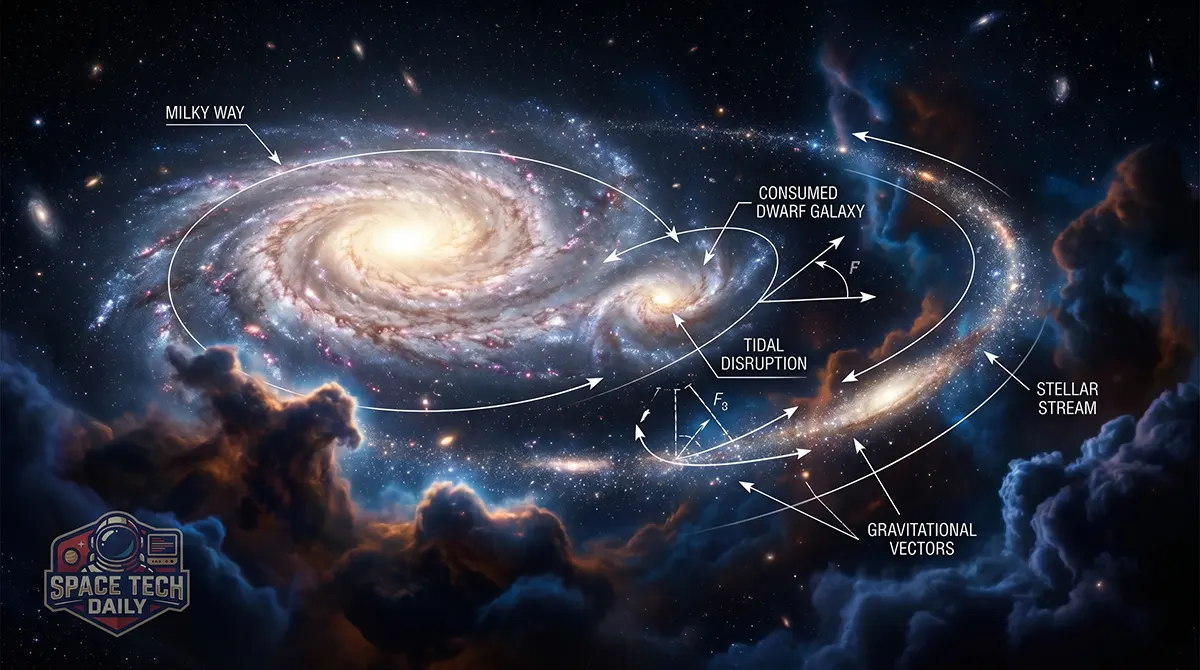
That is the key physical point behind the new discovery Milky Way ate galaxy interpretation. A merger does not simply drop stars into one neat orbital class. Gravitational scattering, tidal stripping, and the changing mass of the host galaxy can redistribute stars in more than one direction.
According to the study, 11 stars move in a prograde orbit, meaning they circle the Milky Way in the same direction as the disk. Nine move retrograde, in the opposite direction. That split is unusual, but it is not impossible if the merger happened very early, when the Milky Way’s gravitational potential was still shallow.
This is where the timing becomes critical. A galaxy that is still assembling itself can more easily absorb and mix an incoming system without immediately erasing the orbital fingerprints. If the merger happened too late, the stars would have been more tightly constrained by the mature disk structure. The fact that they still appear mixed suggests an ancient event.
What “Metal-Poor” Really Tells Us About the Stars
Astronomers use metal content as a shorthand for age and origin, but the reasoning deserves care. In astrophysics, “metals” means everything heavier than hydrogen and helium. The first stars had almost none of these elements because the early universe had not yet gone through many cycles of stellar birth and death.
As stars live and die, they enrich surrounding gas with heavier elements. That means later generations tend to form with higher metallicity. So when astronomers find stars that are very metal-poor, they often suspect they formed early or in small systems with limited chemical recycling.
That does not mean every metal-poor star is a relic of a lost galaxy. Some formed in the Milky Way itself, especially in its earliest phases. But if a cluster of such stars shares both chemistry and orbital behavior, the odds improve that they came from the same external system.
The study authors argue that the 20 stars may share a birth environment, and that shared environment may have been a dwarf galaxy later torn apart by the Milky Way. If true, the chemical fingerprint becomes a record of a destroyed stellar system rather than just an old population inside our own galaxy.
This is the kind of inference astronomy depends on all the time: one observation rarely closes the case, but several independent clues can make a hypothesis much more persuasive. Here, the chemistry and the orbits point in the same direction, even if they do not yet force a final conclusion.
Why the Loki Name Fits the Problem
The researchers nicknamed the possible ancient galaxy Loki, and that choice is more than a bit of mythological flair. Loki is a fitting label because the stars behaved in a way that initially seemed contradictory. Some move with the disk, others against it, and all of them may still belong to the same shredded system.
That is the sort of complication that makes galactic archaeology difficult. A merger is not a clean event. Stars can be stripped at different points in the interaction, then scattered by the Milky Way’s evolving gravity. What looks like contradiction can be the natural result of a messy dynamical history.
The name also reminds us not to overstate the case. A proposed galaxy remnant is not a confirmed galaxy until other evidence supports it. There are always alternative explanations, including the possibility that these stars reflect more than one merger event rather than a single, unified system.
That caution matters because astronomy has seen similar cases before. Some supposed merger remnants eventually turned out to be parts of known structures, or overlapping debris from multiple accretion events. The job now is to test whether Loki is really distinct, or just a useful label for a complicated region of stellar history.
What the Study Suggests About the Milky Way’s Early Growth
If Loki is real, then the Milky Way did not grow only by gradually adding small amounts of matter over time. It also experienced at least one substantial early merger that helped shape the structure we see now. That fits the broader picture of galaxy formation, where large systems build themselves by accreting smaller ones.
The Milky Way already has one famous major merger in its record: Gaia-Sausage-Enceladus, which likely occurred between 8 and 10 billion years ago. That event appears to have strongly affected the Galaxy’s inner structure and helped transition it from a more chaotic early state to a steadier disk-building phase.
The Loki candidate could represent another major event, possibly earlier. If so, it would imply that the Milky Way’s growth was more complex than a single defining merger followed by quiet evolution. Instead, several substantial interactions may have shaped the Galaxy’s early anatomy.
That is why the new discovery Milky Way ate galaxy idea matters beyond one unusual set of stars. It asks whether we are missing a major chapter in the Galaxy’s formation story. If the answer is yes, then some of our present models of early disk assembly may need revision, not because they are wrong in broad outline, but because they are incomplete.
Why Orbital Direction Does Not Automatically Disprove a Common Origin
At first glance, the mixed orbital directions sound like a problem. If these stars came from one dwarf galaxy, why do some go prograde and others retrograde? The answer lies in the fact that the merger happened inside a changing gravitational environment, not inside a static clockwork.
When a smaller galaxy falls into a larger one, tidal forces stretch and strip its stars. Those stars do not all leave with the same velocities or angles. Some can end up sharing the host galaxy’s rotational direction, especially if the interaction occurs when the host is still relatively small and its potential is weak.
That is why the study authors argue the merger must have happened very early, perhaps within the first 3 to 4 billion years after the Big Bang. At that stage, the Milky Way was not yet the massive, settled disk we see today. It was still assembling mass, and that made the gravitational outcome less restrictive.
So the mixed orbits are not a fatal flaw. They are a clue about timing. The orbit distribution itself may be telling us when the merger happened, not whether it happened. That is a subtle but important distinction, and it is exactly the kind of distinction careful astronomy depends on.
What Would Count as Stronger Proof
The next step is not to tell a better story. It is to test the one already on the table. Larger stellar surveys, deeper chemical measurements, and better dynamical modeling will all matter here. The question is whether the 20 stars remain a coherent population as the data improve.
A convincing case would need more than just a shared metal-poor label. Researchers would want to see a tighter chemical pattern across multiple elements, not just iron content, because different nucleosynthesis channels leave different signatures. They would also want orbital clustering that survives better models of the Milky Way’s gravity.
If future data show that Loki stars form a distinct family, the case for an ancient merger gets stronger. If the sample breaks apart into several unrelated groups, then the original idea weakens. Either result would still be useful, because both would improve our map of the Galaxy’s hidden structure.
Here is the practical takeaway:
- chemistry can reveal common origin,
- orbital motion can reveal dynamical history,
- and the combination can expose merger debris that imaging alone would miss.
That is why studies like this matter. They do not just name old stars. They help reconstruct how a galaxy built itself piece by piece, long before the Solar System existed.
A Better Way to Think About Galactic History
People often imagine galaxies as fixed objects with neat borders, but that is not how they behave. A large galaxy is more like a long-lived gravitational archive, carrying traces of past encounters in its stars, gas, and motion. The Milky Way is especially good at hiding its own history.
That is what makes the new discovery Milky Way ate galaxy result so appealing. It is not a dramatic claim that overturns everything. It is a careful hint that the Galaxy may contain a major fossil merger we had not recognized before, tucked closer to the disk than expected.
The best science in this area tends to move slowly, because the evidence is indirect and the systems are complicated. But that slowness is a strength, not a weakness. It means astronomers are working from physics, not from narrative convenience, and they are willing to let the data narrow the possibilities.
If Loki survives future tests, it will not just be another named merger. It will be a reminder that the Milky Way’s past is still hiding in plain sight, written into the motions and chemistry of stars we have only just learned how to read.